
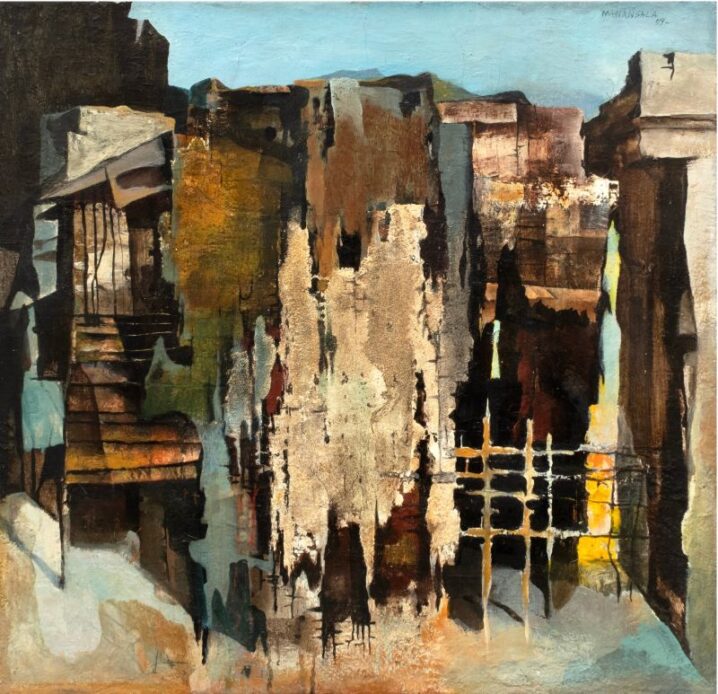
‘Intramuros,’ Vicente Manansala’s experimental masterwork that integrates oil with cement and poignantly depicts the ruins of the Walled City of Intramuros, a place he once called home as a young boy, is a highlight of León Gallery’s ‘The Magnificent September Auction’ on September 12, 2026. The painting is from the collection of lawyer Don J. Antonio Araneta, one of the most prominent and prolific of the ‘First Generation’ of Filipino art collectors.
Vicente Manansala once called Intramuros his home. When he was four years old, the Manansala family moved to the walled city from their home in Macabebe, Pampanga, settling in an accesoria on Calle Real. His neighbors and playmates were also future artists: the sculptor Jose Alcantara (who lived next door), painter Antonio Dumlao, and lyric soprano Elsa Aenelle, the daughter of the owner of the house the Manansala family was renting.
As a young boy, Manansala played and frolicked atop the centuries-old walls of the former capital, treating them as if those bulwarks and ramparts were waves to be adventurously surfed and ridden.
Rod. Paras-Perez wrote in his book on Manansala: “A happy afternoon meant walking atop the beveled fence of the San Agustin Church. Or making his own toys because he was too poor to buy any. He made his kites and flew them on top of the muelle de la muralla.”
It was also in Intramuros where Manansala early on experienced the toils of earning a living. He became a bootblack, a newsboy, a caddy, and a distributor of programs at movie houses. Growing up experiencing these hardships, Manansala became a feisty boy who, in the words of Paras-Perez, “preferred to do the bullying rather than be bullied.” Ultimately, Manansala became an alpha male of the block.
The Intramuros of the American colonial era was not the same Intramuros of the old Spanish empire. It was already stripped of its former glory, slowly deteriorating, as the nucleus of government, businesses, and social activities had already moved to Downtown Manila and the posh districts of Ermita, Malate, San Miguel, and Santa Ana. It was a sharp contrast to the backdrop of the new and modernized Manila that America had envisioned, the old walls and fortresses whispering the might of an old-world empire and the tolling of the seven churches’ bells reminding the brethren of their Hispanic identity now eclipsed by the shadows of rapid Americanization. Intramuros had become accessible—and now, home—to the common people, the masa, who were once denigrated as indios and barred from access to the old city.
Thanks to his spunky Intramuros years, Manansala learned to fight and fend for himself. Once, he worked as a mess boy in 1934 aboard an English ship named Silver Palm. The assistant steward, a bulky Australian, exploited and overworked him. Fed up, Manansala punched him with such force in the groin. When the ship docked in San Francisco, California, Manansala went to the famed Piccadilly Circus to have some time off. When a “scar-faced Filipino toughie” forced Manansala to pay for the former’s entertainment services (he was a circus dancer), the latter thrashed the toughie, who was eventually thrown out of the circus with the help of three Filipino bouncers, all of whom were Manansala’s old friends and hood mates in Intramuros.
It was also in Intramuros that Manansala first discovered his love for art. Reported a September 1958 article in This Week Magazine titled Manansala: The Man and his Work: “At the age of seven, he was already drawing cockroaches, dragonflies, and June bugs. All through the elementary grades, he and Dumlao…walked barefoot to the University of the Philippines (UP) [Escuela de] Bellas Artes on R. Hidalgo for free art lessons.” Manansala fiddled with his imagination and unleashed his raw creativity by making his own toys, since they did not have enough to buy even a few.
Manansala’s fondness for Intramuros never seemed to falter, even after he had already moved out of the old city, as if staying true to the title once conferred to it by the King of Spain: Insigne y siempre leal—Distinguished and Most Loyal City.
After Intramuros was razed to the ground by the combined forces of Japanese and American indiscriminate artillery firing during the Battle of Manila, barung-barong or shanty houses rose from the ground. Intramuros became known as a shanty town, peopled by the helpless populace who sought immediate relief and shelter from the ravages and trauma of the war.
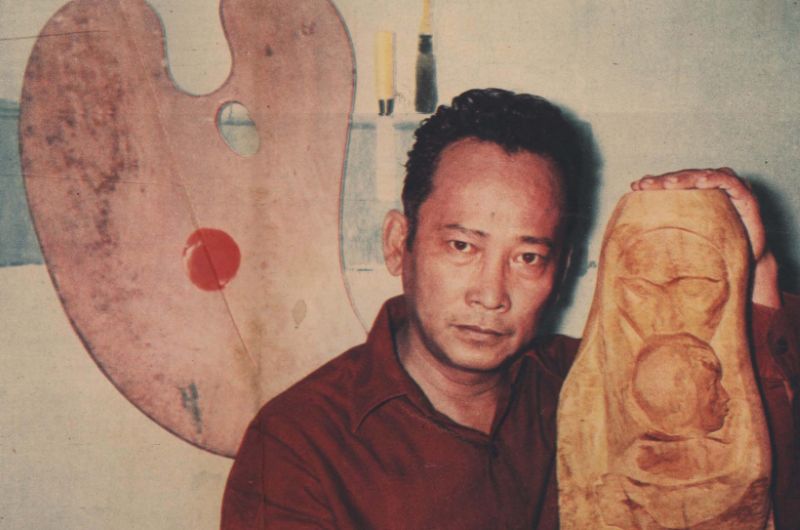
Manansala on the cover of ‘This Week Magazine,’ 21 September 1958 issue
In this 1959 painting depicting the war-torn and desolate ruins of Intramuros, images of the barung-barong and the destroyed walls are rendered in an abstract expressionist manner, with the subject looking like calligraphic transcriptions of reality. When Manansala painted this work, he had already become the most prolific painter in the Philippines, with the highly popular This Week Magazine honoring him as the country’s most outstanding painter, being chosen by a board of judges composed of artists, critics, and collectors, including president and founder of the influential Art Association of the Philippines (AAP) Purita Kalaw-Ledesma, then- UP Fine Arts dean Dominador Castañeda, legendary architect and first-generation art collector Don Luis Araneta, and then-University of Santo Tomas Fine Arts dean Victorio Edades. Manansala had just entered the prime years of his career as an artist, having won top prizes at the annual AAP competitions and even in international exhibitions, specifically the major award for “Best Philippine Entry” for his painting Musikero at the 2nd Spanish-American Biennial in Cuba in 1953.
Intramuros is also an experimental Manansala work, with the artist chaotically integrating cement into the canvas, as if mimicking the war-torn walls of Intramuros and the degraded environment and desolate atmosphere of the once-glorious city he had called home, stripped of its dignity and left to succumb to grave dishonor.
Manansala was the first Filipino artist to treat the barung-barong as a potent subject. Wrote This Week: “After the war, he worked as a staff artist of the Evening News and lived in the slums of Reina Regente [in Binondo], among the barung-barong of the squatters. It was here that he got the idea for his barung-barong paintings, which started a trend in Philippine painting.”
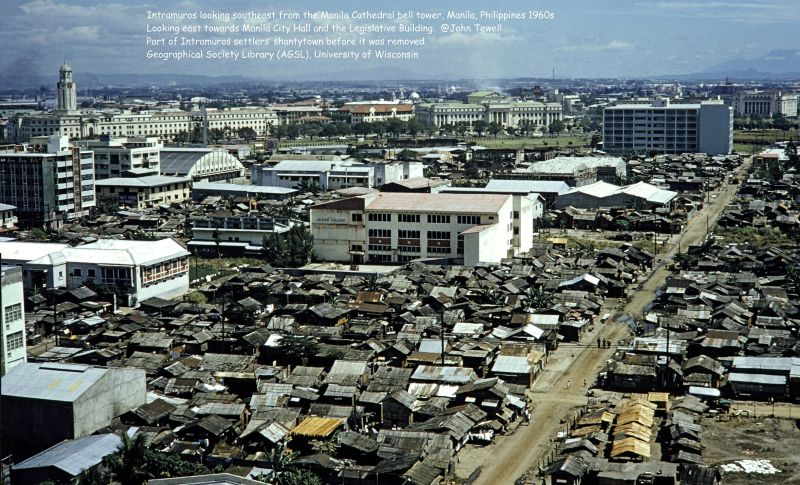
An aerial view of war-torn Intramuros with its shantytown, looking southeast from the Manila Cathedral bell tower, ca. 1960s. Photo from the John Tewell Collection (Flickr), image from the original 35mm color slide in the collections at the American Geographical Society Library (AGSL), University of Wisconsin-Milwaukee, USA
Here, Manansala presents a tension-filled compactness, in which the barong-barong and the ruined walls of Intramuros are tightly interwoven through interlocked planes and a color palette limited to browns and greys. It was as if Manansala was saying that the barong-barong hasd now become the sole identity of the Intramuros he once knew: a bleak landscape bearing the brunt of the brutal Battle of Manila. It can be said that this 1959 painting was one of the settings of his seminal 1950 work, Madonna of the Slums.
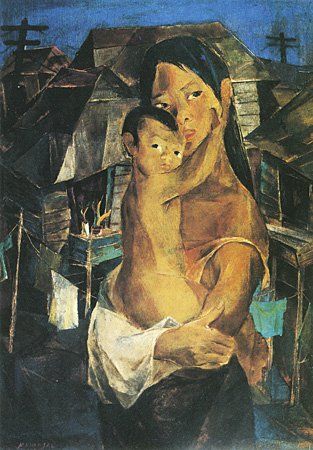
Manansala’s ‘Intramuros ‘can be vividly imagined as the setting of his iconic 1950 work,
‘Madonna of the Slums,’ one of the most important modernist paintings of the post-war era. From the ‘CCP Encyclopedia of Philippine Art,’ photo courtesy of Ronna Manansala
Manansala’s earlier iterations of his barung-barong gave him several significant nods, including First Prize for Barung-barong No. 1 and Honorable Mention for Barung-barong No. 2 at the Manila Grand Opera House Exhibition for the AAP in 1950. The work at hand follows a similar trajectory; it captures Manansala at the peak of his powers, showcasing his profound ability for creative introspection and the artistic intensity that he exudes, which appeals to both the senses and the mind, while knowing how to maintain restraint to deliver his message and capture just the right feeling easily.
León Gallery’s “The Magnificent September Auction 2026” will be held on Saturday, 12 September 2026, at 2 pm. The preview exhibit will run from September 5 to September 11, from 9 am to 7 pm, at G/F Eurovilla 1, Rufino corner Legazpi Streets, Legazpi Village, Makati City.
To browse the online catalog, visit https://leon-gallery.com/. For further inquiries, email info@leon-gallery.com or contact tel. no. 8856-2781. Follow León Gallery on their social media pages for timely updates: Facebook: www.facebook.com/leongallerymakati and Instagram: @leongallerymakati.


