

It began with Meg launching an advice column, “Dear Meg,” at the height of the pandemic to provide some comfort to the sad and unsettled. Then “Dear Meg” came out in pinoyweekly.org and a Facebook page with the same name. In 2022, Gantala Press collated the columns and published the book Dear Meg: Advice on Life, Love, and the Struggle.
In the book, Meg, a stranger, listens without prejudice. She speaks her mind without condescension. She teaches without pontificating. She counsels without heightening feelings of guilt, hopelessness, remorse, or quiet desperation.
The draconian pandemic measures are gone but her words ring with truth to this day, transcending gender, race, religion, and sociopolitical consciousness. Amazingly, those who like going down the rabbit hole of other people’s problems come out enlightened, not brimming with schadenfreude.
Meg counsels like a pro because she is one, holding undergraduate and graduate degrees in psychology from the University of the Philippines, Diliman. Her advice, as she puts it, are drawn from the perspective of emancipatory psychology harmonized with wisdom gleaned from “everyone who has shared their life with her.”
Significantly, she doesn’t belittle anyone who’d want to give their two cents’ worth of advice. She tells M in “How do I help as a non-professional?” that compassion is more important than any degree. M wanted to help people facing depression and anxiety, but didn’t have training in counseling.
Meg redefines caring by infusing it with what she “always tried to talk about: hope, kindness, courage.” She champions militant solidarity, a way of caring or looking after one another—in the way activists, for example, do—that’s grounded on equality, presupposing a commitment to “bearing what every fellow human bears.”
Militant solidarity is rooted in the concepts of community and the inherent dignity of humans, which is saying that there’s no community if there’s no self, and vice versa. She weaves militant solidarity with the radical self-care concept of American Marxist and feminist activist Angela Davis, heralding a new way of caring.
“[Caring] isn’t simply consuming our way out of anxieties, but a practice shared with others, anchored on connections and a real desire to uplift the human condition,” says Meg. “A new concept of self is connected to those who came before us and those who will come after us. Caring for ourselves is caring for everyone else and vice versa.”
Meg’s answer to J, who asked about community care, deconstructs the commonplace idea of community as transactional, or a token exchange, but as more of soup-making. She explains, citing from an article by Nora Samaran, that token exchange has people keeping track of the care given, passing tokens back and forth. With soup-making, people don’t keep scores. They contribute towards a pot of shared feelings of connection, intimacy, trust, and safety.
Filipino Ana Patricia “Patreng” Non comes to mind. In 2021, she set up a bamboo cart filled with vegetables and other food products during the pandemic in Quezon City, spurring island-wide community care. Later, she opened a community pantry to help those who didn’t have money to buy food.
Meg explains to K in “Reimagining self-care” that self-care shouldn’t shield one from the reality of pain and suffering, which necessitates further isolation. Self-care should be meaningful and sustainable. It should restore the connection with the world and help build communities. After all, points out Meg, our ancestors never lost hope or wallowed in helplessness; they changed course and claimed the future.
Self-care should be meaningful and sustainable. It should restore the connection with the world and help build communities
In “Building community amid precarity,” she commiserates with T who, beset with personal problems, found it difficult to practice self-care in a “precarious environment” and still build communities. She reminds T that human bonds are unconditional; that having no worries isn’t a prerequisite for a relationship; and that the intrinsic, unconditional care for people is the basis for building a community.
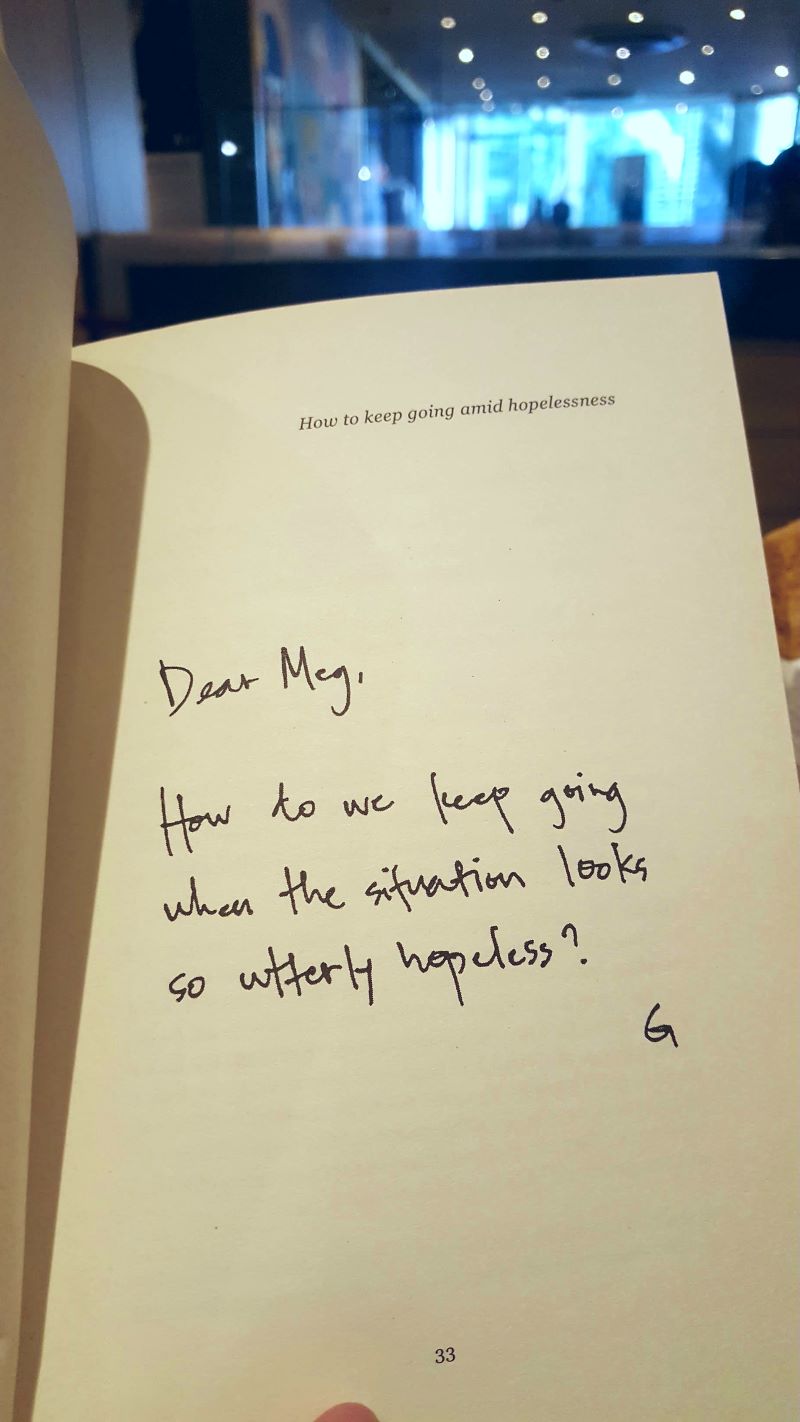
Says Meg, “History banishes fear when one is faced with a bleak future.”
Meg invokes the bigger picture. For example, people were despondent during the pandemic and the residual hopelessness is still hanging over their heads. She tells G, in “How to keep going amid helplessness, that fear is expected in a world wracked by injustice and inequality. However, knowing history helps to restore calmness and clarity particularly when its call to change the world is heeded. With this, she assures G that creativity, strength of spirit, and solidarity will overcome the challenges.
In “Moving past trauma,” she helps A help a friend get over traumatic experiences. She points out that forgetting can only lead to frustration because no one completely forgets. She emphasizes the possibility of change through narrative psychology—aligned with historical materialism—because it stresses the “people’s ability to change the direction of their lives.”
Her reply to M’s question in “How to be brave” is the answer to future unsaid questions with the same thought. She explains the various permutations of bravery in a person’s life, highlighting important aspects.
Firstly, bravery is in our blood, shaped by our colonial past and our heroes and heroines’ fight for independence. Secondly, courage comes and grows as we get to know ourselves well. In turn, knowing ourselves leads to having a community you can put your trust in, and vice versa.
Significantly, a person’s bravery grows when challenges—no matter how painful—are taken on. This is because “there’s no growth when we’re contented, that it happens in upheavals,” says Meg.

Meg’s advice on love doesn’t hew to the conformist view.
Meg’s answers on queries about love are never cut-and-dried. They’re uplifting; they shatter stereotypical notions about love/romance in a capitalist system. M’s question—”How do you know you’re in a healthy relationship?”—has Meg expounding on the interconnection of relationships with gender roles and expectations.
Elsewhere, advice and answers would run the gamut of the partner’s green flags to look out for, anniversary gift ideas, etc. Not with Meg. Deep-diving into the concept of a healthy relationship, she elucidates on how the community-bolstered patriarchal ethos shapes relationships. Binary opposites, for instance, have had men, being the strong providers and protectors, treating women like property. Meanwhile, women have internalized their secondary role, conformed to society’s standards, and, lamentably, seen other women as a threat. Meg argues that without such impositions, anyone can experience a healthy relationship that celebrates a person and makes them grow.
Running on parallel lines is Meg’s counsel to N who asked for her thoughts on daydreaming about past relationships. Turning the tables, Meg asks N: How did it feel? Did the memories stop the exploration of new possibilities with other people? Did it inspire to cherish life and make new memories?
The bottom line: Ruminating about the past is worthwhile only if brings one to a place of joy or a better understanding of one’s self.
Meg discredits the unfair imagery—and accompanying opprobrium—of the politically engaged described in the likeness of Snow White’s evil, cold hearted stepmother. They’re not Atlas either despite bearing the world on their shoulders like the Greek Titan. They’re just regular humans faced with issues like smoking and sexuality, wrote Dr. Michael Tan in one of the book blurbs.
In “Grief in the movement,” Meg counsels G by, first, acknowledging G’s pain in losing a friend who’d helped to “redefine knowledge, relations, growth, and success.” She tells G to honor the pain because, one, it’s human to grieve a loss and, two, it’s part of concrete realities. Next, she encourages G to create spaces to let go of feelings of loss and “pay tribute to the principles they lived and died for.” Or, she says, G could find time to be alone, which is another way to heal.
She adds: “It will be hard for some time, but it gets better.”
She tells G to honor the pain because, one, it’s human to grieve a loss and, two, it’s part of concrete realities…Or, she says, G could find time to be alone, which is another way to heal
In the same vein, politicized individuals can suffer from mental health problems. Meg advises G, in “Supporting a comrade with anxiety and depression,” to listen to the friend to find out what they need and reassure them that things will get better. She also tells G to be healthy, to remain the friend’s pillar of strength.
Meg’s article “Wanda and his quiet resolve” is a poignant tribute to the late Wendell aka Wanda. He was, she remembers, a simple person with lofty ideals. He was never worried about being able to wear branded clothing or to hang out in hip places. He carried his things in a plastic shopping bag and never raised his voice, or lost his temper during arguments, or complained about the tasks given to him.
She writes, “To be able to do away with excess and resist the trappings of money and power are virtues of an activist, and how Wendell embodied them! I nodded when…Pastor Genesis talked about self-denial for a bigger purpose as a lesson that can be learned from Wanda…a gay man who overcame the expectations of the petty-bourgeois world [and] the limitations of his eyesight and slight frame.”
Giving advice isn’t as easy as one thinks it is. Listening isn’t asking questions to complete the story in our heads, but helping the troubled person see the way out of a dark, tumultuous time, says Meg. Tellingly, it means overcoming the prejudices extended by class, education, and religion.
Admittedly, prejudices are formidable to surmount as they mean putting others before one’s self, like what Wanda et al. did. However, Meg believes in the possibility of change, exhorting it in the essay “History and narratives.”
Writes Meg, “Our history can change: we hold it in the palm of our hands. We can rewrite, we can redeem our country’s narrative.”
Her certainty lies in the power of words to effect change despite obstacles and differences, i.e., upbringing, personalities, ways of expressions. She admits to the inevitability of conflicts, but says words can be tempered through calmness, mindfulness, etc. to keep conversations on nation- building going.
Imagine a community — or world even — that’s equal, in harmony, and just. It’s not impossible to achieve, if we try.
Dear Meg: Advice on Life, Love, and the Struggle is available on shopee.ph and Puón Books in San Fernando, La Union (@puonbookshop).


