
Photos by Aphro
Milo Naval’s ‘Yakisugi’ exhibit runs July 21-Aug. 22, 2026 at Aphro, The Alley at Karrivin, 2316 Chino Roces Avenue, Makati City.
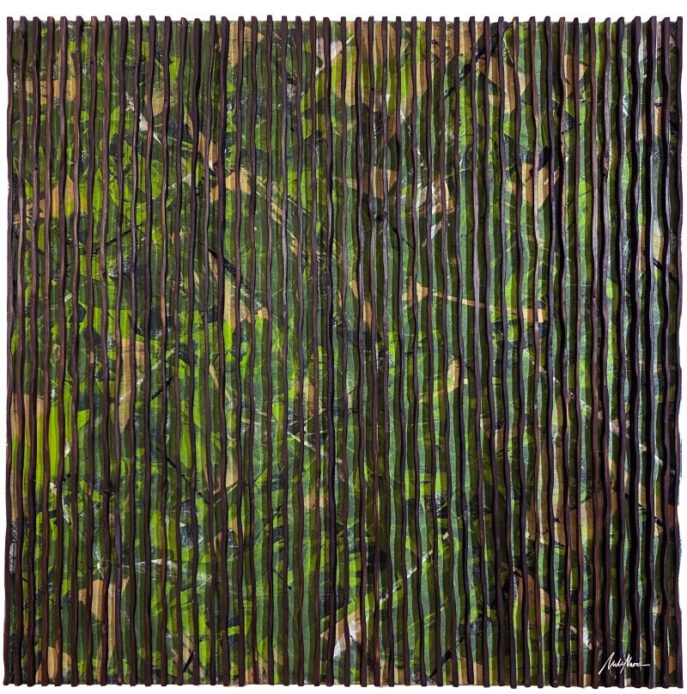
When designer Milo Naval was a young boy, he would peer through the grilled window of the silong (basement) of his grandmother’s house, gazing out at the lush greenery beyond. Decades later, he captures that childhood memory in Rainforest, a square mixed-media relief where vibrant patches of emerald green, olive, and earthy brown interlock beneath a veil of slim, dark vertical slats.
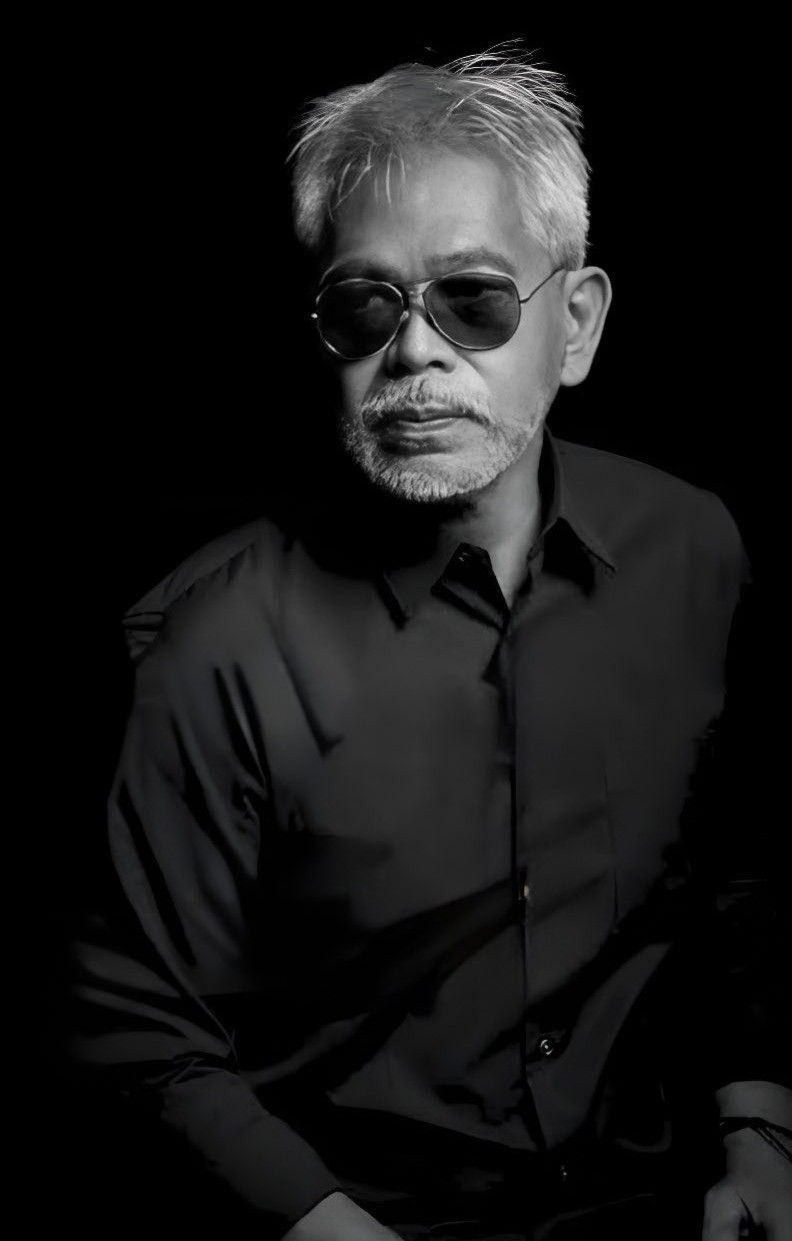
Milo Naval: Artworks that can shape the energy and balance of a space
Hand-finished wooden lines create a rhythmic screen across the surface, adding depth and transforming the work, depending on where the viewer stands. Up front, the viewer feels like looking through a window into a dense forest canopy. From the side, the view disappears into black.
“If you look at it from the front, it’s like looking through the window. If you go to the side, all you see is black,” he explains.
The blackened slats were created using the ancient Japanese yakisugi method, which chars the wood’s surface to make it naturally more durable and resistant to insects and decay. It extends the wood’s life and reduces the need for chemical treatments and frequent replacement.
Naval became enamored with the technique, and named after it his first solo exhibition at Aphro, organized by gallerist Tina Fernandez. She tells TheDiarist.ph that this gallery has become a home for artists who want to experiment with functional objects, and for designers she has admired over the years who create one-of-a-kind and limited-edition pieces. “They all know Aphro welcomes beautiful crazy ideas,” she says.
To understand Naval’s art, it helps to first understand the designer behind it. His work has always been rooted in a minimalist, natural aesthetic, with a keen eye for the interplay of material, texture, and space. That sensibility began taking shape during his childhood in Navotas, where tending a backyard garden sparked an early interest in design, landscaping, and trade.
Naval was an Architecture student at the University of Santo Tomas in 1974, when his education was interrupted after he was diagnosed of bone cancer that led to the amputation of his left leg. After years of rehabilitation, he returned to his studies, eventually shifting to interior design at the Philippine School for Interior Design. He soon gained practical experience designing retail spaces and learning the intricacies of furniture manufacturing.
That technical foundation led to the launch of Evolve Design at Manila FAME in 1998. The company won Best Booth, while its cylindrical shell-and-woven lamp was named Best Accessory at the Likha Awards. The following year, Naval was invited by the Center for International Trade and Export Missions (CITEM) to join Movement 8, a premier collective of Filipino designers promoting contemporary Philippine design abroad. The group championed local materials as a way to establish a distinctive identity in the international market.
Determined to build a personal brand, Naval later founded OMO, short for “On My Own,” guided by the principle that form and material should directly serve function. His furniture is pared-back yet tactile, allowing natural materials, precise craftsmanship, and subtle contrasts in texture to do the visual work. Those same principles now underpin his art, where material and surface become the subject rather than simply the means.
His furniture is pared-back yet tactile, allowing natural materials, precise craftsmanship, and subtle contrasts in texture to do the visual work
In recent years, Naval has expanded into abstract art, bringing the woodworking techniques he mastered over decades, including precision sanding and spray-gun application, to his canvases. He now integrates these paintings in his interior design work and hospitality projects. To critics who dismiss the canvases as merely decorative, Naval has a different view. He sees them as functional architectural elements, artworks that can shape the energy and balance of a space.
We discovered Naval’s foray into art when we visited his residence, hotel, and resort in Sorsogon, where his paintings add life to interiors. In one artwork, his mastery of surface finishing is evident in a dense composition of swirling, concentric rings that recall natural wood grain or rippling water. Sweeping black marks against a pale panel create a sense of movement and energy.
Another work takes a more expressive approach, with a dense web of splattered black, white, ochre, and deep crimson lines crossing a stark white canvas. The layered rush of pigment evokes a wild, tangled landscape.
In another, Naval puts his spray-gun skills, honed during years of crafting fine furniture, to striking effect. Glowing, translucent yellow-green forms float against a matte black field, their soft, overlapping shapes resembling stones or cells. The composition brings a sense of calm, designed to sit naturally in a modern living space.
Naval’s work raises a larger question: When does an object made for everyday use become art? Around the world, designers are pushing beyond function, blurring the line between craft and contemporary art.
The designer stepped into that territory when he curated the Philippines’ inaugural showcase at Révélations 2025, the prestigious international craft biennial at the Grand Palais in Paris. For Le Banquet des Philippines (The Banquet of the Philippines), he created an installation of stacked discs and ellipses framed in his signature metalwork. The island-like forms evoked the Philippine archipelago, with its geographic divisions and sense of national unity.
Drawing from the materials and heritage of Bicol, the piece showcased the tactile beauty of abaca, buri, and raffia. Women from a community in Gubat, Sorsogon, hand-crafted the intricate weaving and knotting, while delicate shell and crochet accents were made by an artisanal exporter in Albay. The piece honored traditional craftsmanship while reflecting Naval’s shift from furniture and interior design to studio craft and abstract painting.
Naval’s move into fine art gained momentum when he joined a group exhibition at ArtistSpace at Ayala Museum Annex last year. He presented a yakisugi-made lattice set against a yellowish background, Rainforest, and a wall sculpture of intersecting charred beams that resemble a fallen skeletal tree, accented with gold concentric rings.
At his solo inaugural exhibition, Naval further explores these subjects. His works invite you to stop and look. Like abstract paintings that rely on color, light, and mood rather than a literal subject, they reveal themselves slowly. The yakisugi series draws on the elements of rain, storm, and sun.
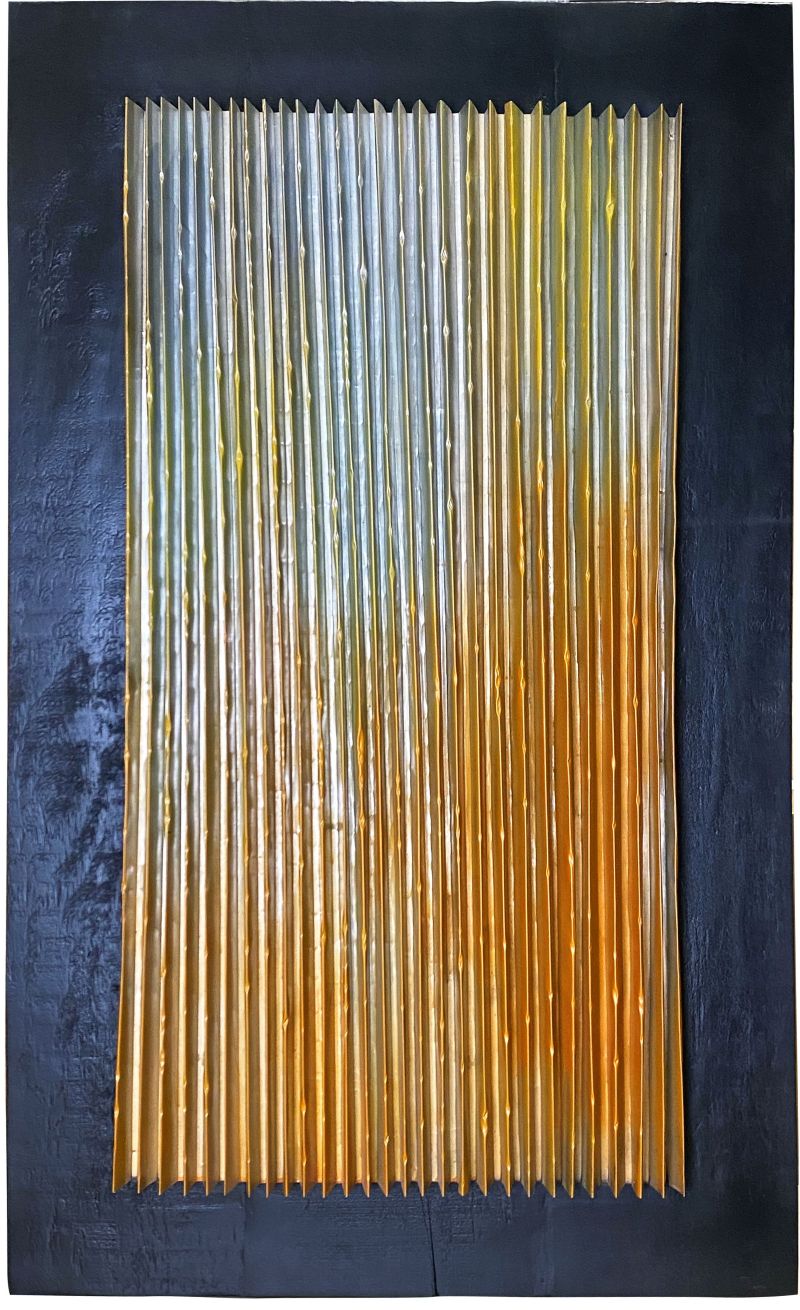
‘Sunrise and Sunset’
Set against a dark, textured yakisugi backdrop, Sunrise and Sunset features a central accordion-folded panel that catches the light. The color shifts from cool, silvery tones at the top to warm amber-gold at the base, suggesting the changing light of dawn and dusk. Its corrugated, yakisugi-finished folds give the piece a sculptural quality, with shadows and reflections shifting as you move around it.
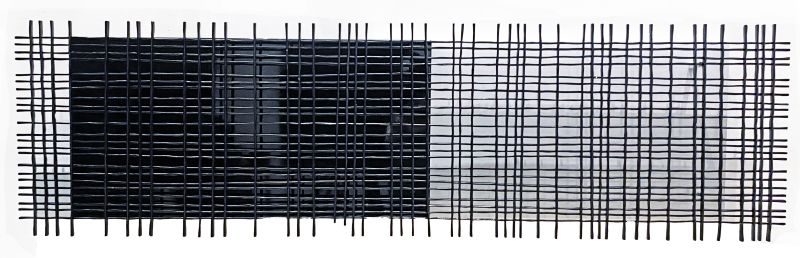
Ebony and Ivory
In Ebony and Ivory, a slender yakisugi -finished black lattice stretches across a wide horizontal relief. Behind it, black and white panels create a stark contrast between glossy surfaces and matte wood. The openwork grid adds depth, turning a simple play of color into a study of light, shadow, and balance.
Like abstract paintings that rely on color, light, and mood rather than a literal subject, his works reveal themselves slowly
‘Guides 3’
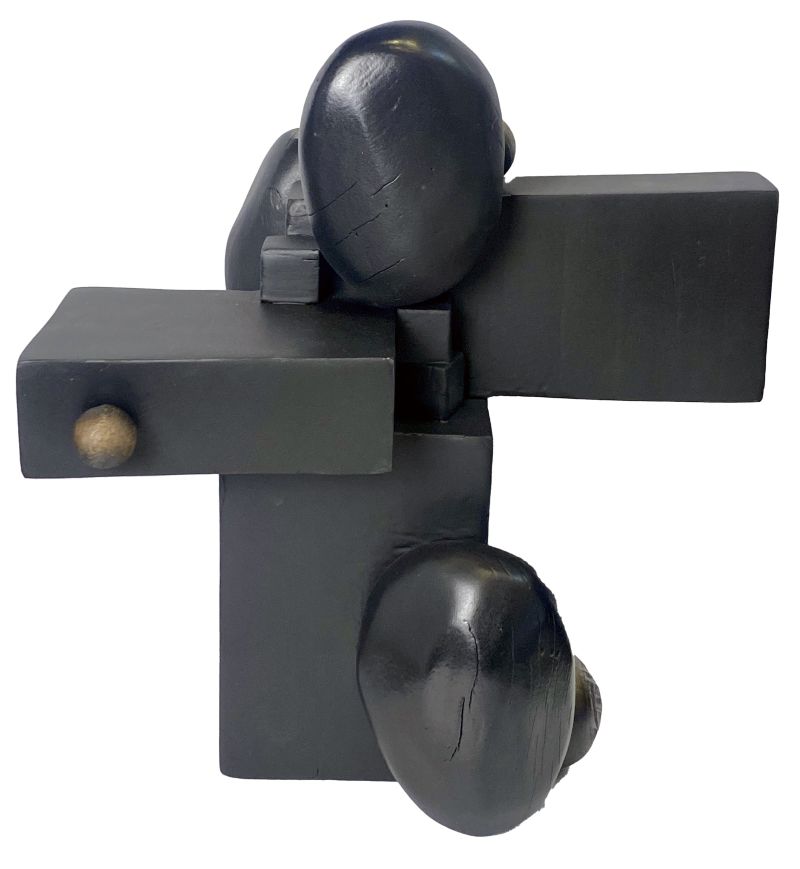
Guides 3 combines hard geometry with softer, organic forms. Matte charcoal blocks interlock with smooth, pebble-like shapes, while a small, raw wooden sphere sits within the left arm. The forms may bring to mind anitos or Cordillera gods, but Naval points out an important distinction. Traditional anitos are hand-carved, while his sculptural forms are shaped using specialized tools and equipment.

‘Kidlat 1’
Kidlat 1 captures the sudden force of lightning in a freestanding sculpture. Dark metallic branches split downward from a single point, like a bolt striking the ground. At the base, scattered charred charcoal flakes contrast with the rigid, frozen movement of the metal.
‘Morning Magic’
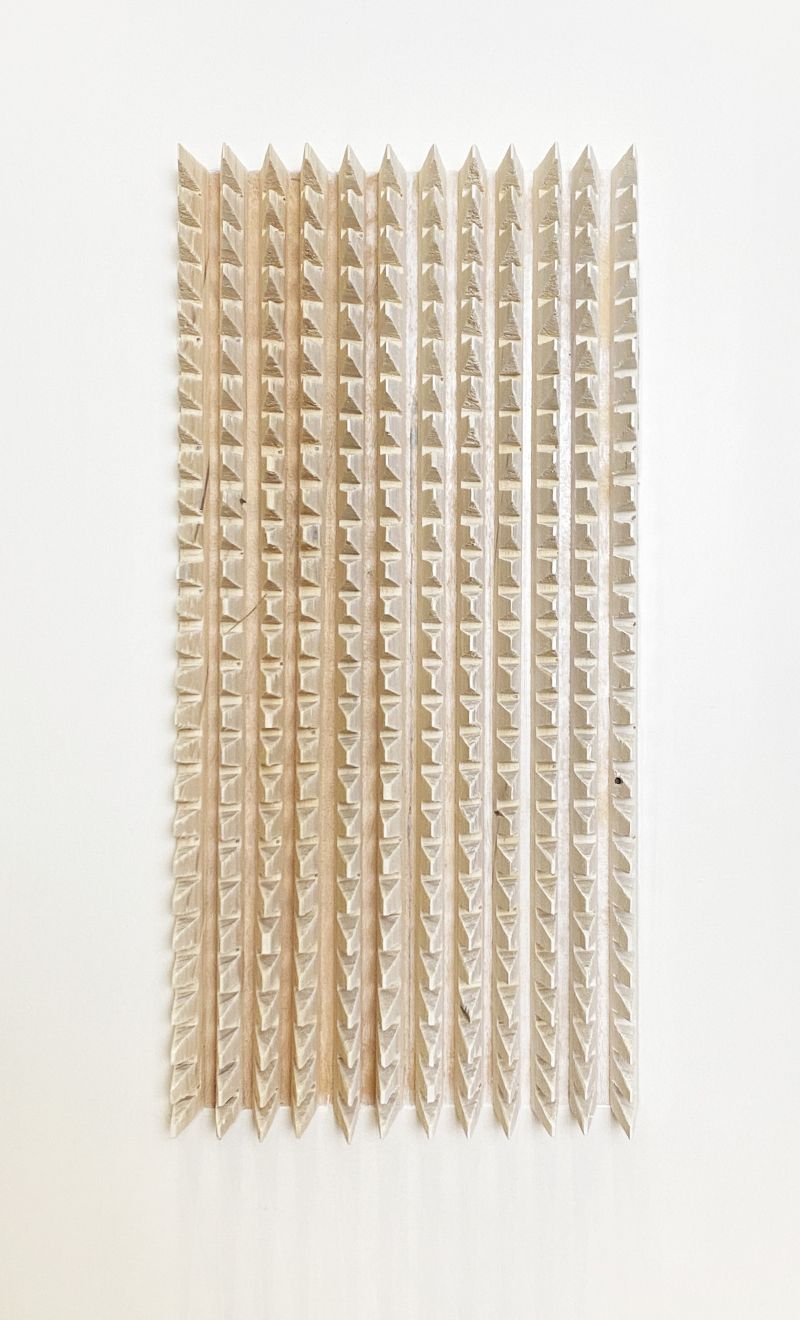
Clean and minimalist, Morning Magic reflects Naval’s penchant for neutral colors and simple lines. A pale raw-wood relief sits against a white background, its central panel carved with tight accordion folds and small triangular ridges. This is one of the many interpretations of rainfall. Light catches the wood grain and geometric edges, creating soft shadows.

‘Renewal 2’
Naval’s favorite, Renewal 2, pairs a horizontal panel of pale, natural-grain wood with a dense field of stiff fibers resembling a coarse brush. The bristled surface gradually shifts from deep charred black on the left to warm, raw tan on the right. Against the smooth wood, the change in color and texture highlights the beauty of natural materials and meticulous craftsmanship. “I do with my furniture, and now with my art,” he says.
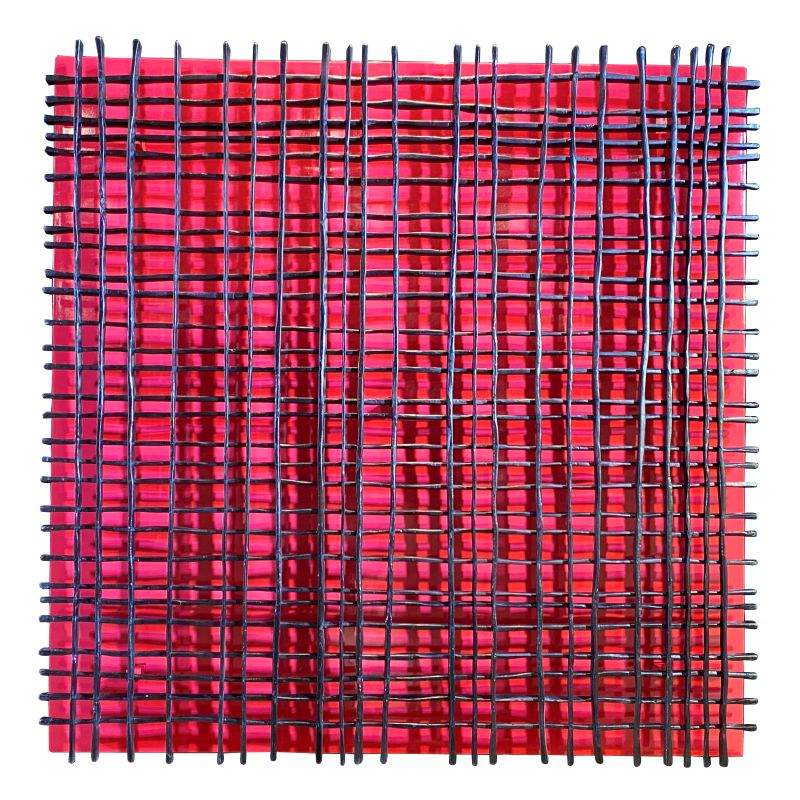
‘Tickled Pink’
Naval has been working with yakisugi for more than a decade, developing the technique through research. He initially applied the method on organic benches and tables, combining charred wood with stainless steel. For him, the technique captures something of nature while offering a new way to treat and preserve wood.
The designer points out a clear difference between manufacturing and art. “In manufacturing, you think of who you’re going to sell to. You think of the market and the bottom line. But in art, you just want to communicate. I’m not thinking of who I’m going to sell it to. I’m just expressing myself.”
That freedom, he says, has allowed him to stay true to his aesthetic. “Even my furniture designs are restrained, and so is my art. This is the person I am. I don’t want to be something else.”
Milo Naval’s ‘Yakisugi’ will be on exhibit at Aphro, The Alley at Karrivin, 2316 Chino Roces Avenue, Makati City from July 21 to August 22, 2026. For updates, follow @aphrolliving.


