
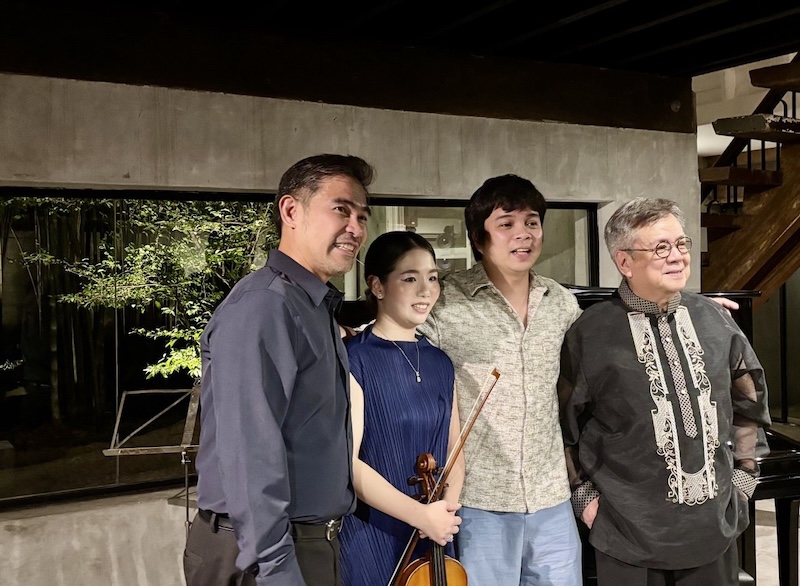
Music impresario and academic Franz Ramirez has a task nearly as old as time—to promote classical music, and the classical artist, in this era of noise and content glut. It is nearly impossible, yet this music artist himself and advocate seems to be getting somewhere, judging from how consistently the Kundiman After Dark, Nicanor Abelardo has been drawing a select yet engaged audience to Sine Pop in Cubao, Quezon City.
This is the chamber music series the latest of which is on Thursday, Feb. 19, 2026, 7 pm, featuring tenor Ervin Lumauag and violinist Shino Takashima, noted composer and pianist Augusto Espino—the third repeat performance of Nicanor Abelardo compositions. The latest was last January (photo and videos here) featuring these same artists.
This Thursday’s program of Abelardo compositions: Kung Hindi Man (1920), Kundiman ng Luha (1924), Cavatina (1921), Capricio Espanol (1923), Fantasie Impromptu (1921), Naku….Kenkoy (1930), Bituing Marikit (1926), Mutya ng Pasig (1926), Nasaan ka Irog (1923).
It follows a Ted Talks format where Ramirez talks about the kundiman—as a genre unique to the Filipino character and history—Abelardo, and his life and music. It is an easy conversation with the audience in between the touching renditions of Abelardo’s most loved masterpieces such as Mutya ng Pasig, Bituing Marikit, Nasaan ka Irog. It is as if this great Filipino composer (1893-1934), who lived such a short life (death at 41 years old) in pre-war Philippines yet left behind a priceless treasure to generations of Filipinos, remains relatable to today’s Filipino, given how he wrote about love and hope, despair and longing, a new beginning. A timeless story for a nation.
The conversations with Ramirez and the artist are informative, light, freewheeling and interesting—like in one’s living room. Before the performance, the small gathering is even asked how many of them took the MRT to get to this venue (a stone’s throw away from Gateway), and a few hands would be raised indeed.
Such attendance and response have been giving Ramirez a lift in his advocacy. For the Kundiman After Dark series to be extended into 2026, it must be gaining a following indeed.
This gives Ramirez hope that indeed the classical artist can have an audience in today’s crowded space.
“First of all, programming should be relatable and the venues somewhat accessible,” Ramirez told TheDiarist.ph. “My aim is mapalapit siya sa (bring closer to) common people, mapalawak yung (broaden) scope, hindi lang (not only) for the select audience.”
He considers it a good sign that there are new venues today, like small theaters for performances, “not only for classical music but also public spaces like museum, libraries, schools, churches—they also give exposure to classical music,” he said.
His aim is to raise the rate of classical artists, if not make it comparable to that of pop artists. There are engagements or gigs, he said, but the classical artists are almost always made to do pop songs.
Despite the odds stacked against them, surprisingly, the enrolment in music continues, if not growing. “Yes, madaming batang may gustong mag (more young people plan to) pursue ng classical music,” Ramirez noted, “but the reality is, after school, there’s still not much opportunity to play classical music. There are those younger than 17 who learn and play classical music. They just need greater exposure.”
And, he added, “they need to develop certain social skills to gain supporters and followers.”
Like other artists, these artists are discovering the need to be on social media.
Ramirez and his fellow classical music advocates find it fulfilling to see new audience each time they do the chamber music series.
“One time, I asked the audience, those with no background in concert or classical music, why they’ve come to Sine Pop series three or four times already.” And their encouraging response is enough to keep Ramirez and his group going.
He concluded, “Need na siguro nating mag kwento (we just have to continue telling the story).”


