
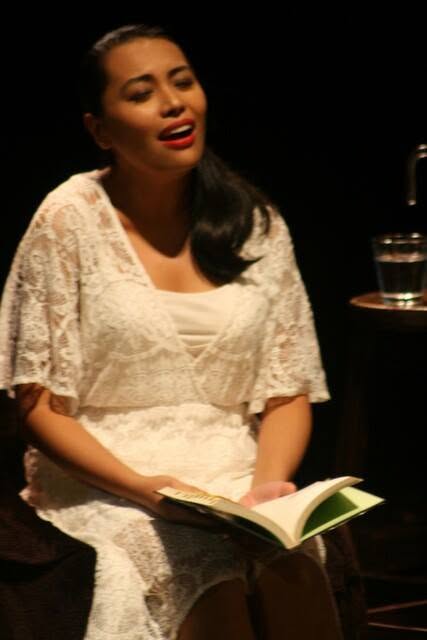
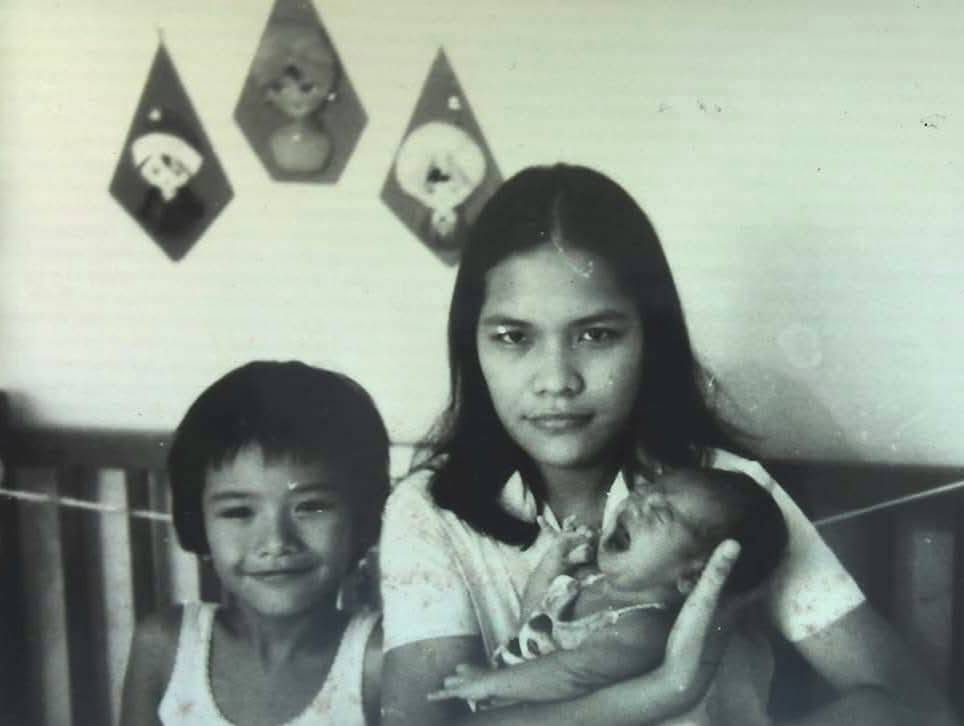
The author with Maningning and Baby Banaue
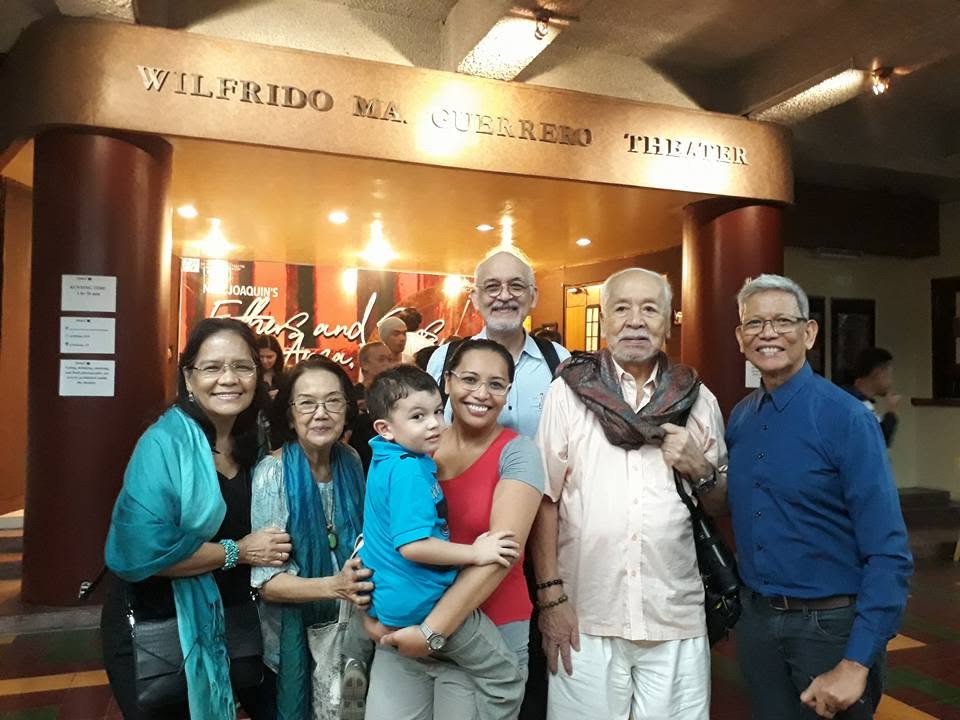
Banaue and family with her mentor Tony Mabesa (second from right) and actor Leo Rialp (second row)
China-born Banaue Miclat, a thespian, lyric soprano, a theater mentor and University of the Philippines (UP) professor, is launching in August a web app called the Healom App. Based on her research as a PhD candidate of the California Institute of Integral Studies in San Franciso, Banaue trademarked her research as the “Healom Way.” A fellowship grantee of the Faculty, REPS and Administrative Staff Development Program (FRASDP) for faculty at UP Diliman for her PhD, Banaue says, “In combining hilom with ‘heal,’ I combine our Filipino practices with other Asian as well as Western practices to create what I call a transformative healing performance process or THPP. With this research, the Healom App will contain exercises for emotional regulation as well as other Healom processes. It is a free app, and I would like to keep it free for all who will join.”
She further says, “My personal research is focused on a process for post-performance decompression so that actors and creatives will be able to let go of dysregulated emotions with more ease and less reliance on emergency psychotherapy sessions.”
The teacher and mentor Banaue recently played the lead role of Lualhati, alternating with Jackie Lou Blanco, in Gab Mactal’s play Lualhati at Virgin Labfest XXI, directed by Mara Paulina Marasigan. The play has been chosen together with two others, Elehiya and Patayin ang mga Surot, to be revisited in the VLF XXII next year.
In 2014, multi-awarded composer Jesse Lucas asked our family’s permission to turn some of the poems of my firstborn Maningning from her trilingual book of poetry, Voice from the Underworld: A Book of Verses, into songs. The Anvil book was launched on Maningning’s 28th birthday in April 2000, five months before she took her life. Jesse also proposed that her sister Banaue sing the compositions.
The result was a performance art production of 13 songs titled Ginugunita Kita, performed by Banaue with Renato Lucas on the cello and Jesse Lucas on the piano. It was premiered at the Aldaba Hall at UP in May 2015, and then at the Cultural Center of the Philippines (CCP) in September that same year, back-to-back with the Maningning Poetry Awards. The successful production had an encore at the Far Eastern University (FEU) Auditorium under the auspices of the FEU Center for the Arts headed by Martin Lopez in September 2018, back-to-back with the Maningning Art Awards.
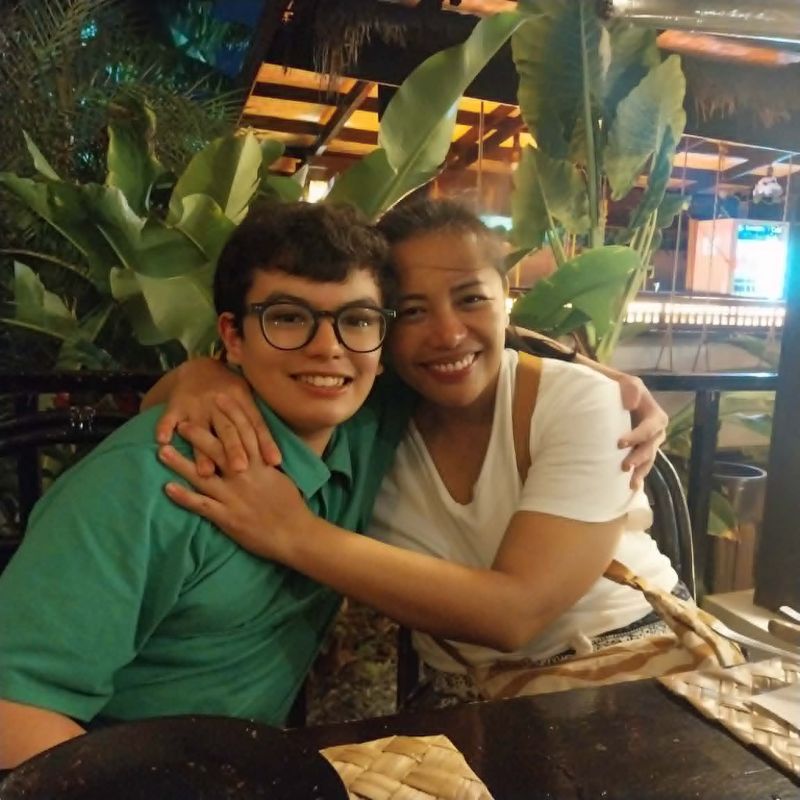
Banaue with 14-year-old son Raja
Banaue recalled the Ginugunita Kita experience, thus: “My trepidation at the possibility of having an emotional breakdown was transformed into an unexpected healing process as I tackled memories choosing anecdotes to honor my sister’s legacy.”
The cathartic experience motivated Banaue to work on a project to help student performers identify possible triggers for mental challenges, and heal these triggers by creating a performance. Through the Enhanced Creative Work and Research Grant for 18 months that she received from UP, she was able to conduct a study and produce a methodology towards creating a trigger project during the COVID-19 lockdown.
Related Story:
Healing, with help from my sister—from heaven
Banaue’s foray into the trigger project, which aims to help performance artists use what they believe is their trigger for a psychological or emotional breakdown to create a cathartic performance, led to her taking up a PhD in Transformative Studies, a transdisciplinary study focused on inquiry-driven research.
Her project aims to help performance artists use what they believe is their trigger for a psychological or emotional breakdown to create a cathartic performance
My younger daughter Banaue had always played second fiddle to her precocious only sibling, poet and visual artist Ate Maningning. Understandably so, since her late sister had a partida, an advantage of being born seven years ahead of Banaue, and therefore with more years of being honed in the art she had been gifted with.
Unlike her quiet and gentle Ate Maningning, energetic Banaue is a force of nature. While the former came out of my womb whimpering, the younger girl announced her presence with a loud, non-stop cry. At the age of 3, she fell from a nursery playground slide which left her with stitches at the back of her head. Another fall at the age of 5 kept her left arm in a sling for a month or so.
While Maningning studied at Yumin Primary School and Beijing Normal University’s Pilot Middle School, we enrolled Banaue at the Chinese-run International School while studying piano with a Chinese pianist. The closed-door China which we encountered when we first arrived in Beijing in 1971 had by this time already been open to the world, which started with Premier Deng Xiaoping’s Open Door Policy in December 1978. The hitherto incognito Miclats had also made friends with some members of the Philippine Embassy, foremost of whom was the ace diplomat Nona Zaldivar. She is the daughter of Calixto Zaldivar, Supreme Court Justice from 1964 to 1974, and best known in Philippine history for being one of only four dissenting voices against the constitutionality of the Philippine 1973 Constitution, despite pressure by Ferdinand Marcos’ authoritarian government to vote in the constitution’s favor.
Serendipitously meeting Master Liu Fulin of Si Junzi Hua or “Four Gentlemen school of painting,” Maningning, who at 9 years old showed her inclination for visual arts, studied under the Chinese master. Every weekend, my husband Mario and I would walk her to the hutong, alley, leading to the master’s abode, a traditional courtyard in Beijing teeming with bamboo and orchids. Those exquisite plants became the subject of her early ink-and-brush paintings.
The brilliant wisp of a girl did not only learn the art of traditional Chinese painting, but also imbibed Chinese classicism, ancient history, and culture from the erudite master who lovingly imparted so much without expecting anything in return. That would serve our Maningning in good stead when we came back to the Philippines after the EDSA People Power Revolution in 1986, and she would hold her first solo show of Chinese brushworks titled Maningning at the CCP in 1987. She was the youngest artist at 15 to hold a solo exhibit there that year.
As well, that year 1987 saw the literary editor of Chinese local newspaper World News, James Na Teng Choon, publishing her book of poetry in Chinese, Wo De Shi (My Poems). The poems in the anthology were published in the literary page of World News, where the teenager Maningning was asked to work part-time translating feature stories from English and Tagalog to Chinese. The poetry collection made her known as one of the top poets in the world writing in Chinese, as published in a book during the United Nations’ Fourth World Conference on Women held in Beijing from September 4 to 15, 1995.
Coming home to the Philippines in 1986, we enrolled the vivacious Banaue at Ben-Lor Ballet Academy of National Artist for Dance Leonor Orosa-Goquingco during summer vacation, while her Ate Maningning joined Rio Alma’s Poetry Clinic that led to membership in the group of poets, LIRA (Linangan sa Imahen, Retorika at Anyo). Banaue would complain about some little girls who would look at her with contempt, saying “hindi ako kasing payat nila at malapad ang paa ko.” (I’m not as slim as them and I’ve got big, wide feet.) Still, she was able to do her first stage performance as a 9-year-old ballet dancer in the Collezioné ’89 recital.
When she was a little older, we enrolled her at the St. Theresa’s College Ballet School of our friend Felicitas “Tita” Radaic, even as she was a UP Integrated School student. But when they were to perform onstage and would need a set of costumes, her Tatay Mario said we couldn’t afford it. Indeed, we could not, as we were struggling financially even as we were both working, he as instructor at the University of the Philippines Asian Center, a graduate school for Philippine and Asian Studies, while I was selling Collier’s Encyclopedia, RTW, and tocino and longanisa from Patits’ home products of our friends Mario and Linda Pamintuan.
In lieu of ballet, her father inquired about enrolling the 12-year-old Banaue in Pthe Philippine Educational Theater Association’s (PETA) teen theater workshop. Then they saw that Peta was holding auditions for Radiya Mangandiri. She auditioned and passed. It was a workshop production, so she got a stipend for her role as the young Sita in Ang Paglalakbay ni Radiya Mangandiri, based on the Hindu epic, the Ramayana. It was written by the multi-awarded playwright Rody Vera. She was so invested in theater that she could recite all the lines of all the actors.
That was the young Banaue—a force of nature who would always have something to do or perform during summer breaks. When she joined the Ramon Obusan Folkloric Group (ROFG) while in high school, the group’s iconic founder, who would become National Artist for Dance in 2006, so liked her gracefulness, stage presence, and cheerful nature that he asked her to join the group’s world tour, which would last for six months, disrupting her schooling. Mario and I had to put our foot down. We firmly told Banaue to study first and do whatever she wanted to do after finishing college.
Well, what did you know? She passed the UP College Admission Test, enrolled in Bachelor of Arts in Theater Arts, and did what she had always wanted to do. As a student, she took on heavy roles at Dulaang UP, like Gregoria de Jesus, Bonifacio’s wife, in Adrian Cristobal’s The Trial/Ang Paglilitis in both Filipino and English versions, directed by Alexander Cortez. Not only did the play have an extended run; it was also toured in other cities all over the Philippines.
She also played the role of Desdemona in Shakespeare’s Othello under the direction of Antonio “Tony” Mabesa, her UP mentor who would become National Artist for Theater in 2022. She was in dramatic plays, such as Floy Quintos’ …And St. Louis Loves Dem Filipinos, Federico Garcia Lorca’s Boda de Sangre (Blood Wedding), as well as in Ramón del Valle-Inclán’s Divinas Palabras directed by José Estrella. They presented the play in both Spanish and Filipino translation by Jerry Respeto.
For her undergraduate thesis, Banaue played the lead role in Mario O’Hara’s Palasyo ni Valentin under the helm of Tony Mabesa. The play, which won first prize in the 1998 Philippine Centennial Literary Awards, was produced by the UP Playwrights Theater, and as such, Banaue’s parents did not spend a single centavo for her thesis production. It also had successful runs at the Wilfrido Ma. Guerrero Theater at the UP College of Arts and Letters.
In an interview with the late writer and journalist Amadis Ma. Guerrero, Banaue was quoted as saying that “the beautiful thing about Sir Tony is that he gives you blocking and you’re supposed to find the meaning and impetus of the blocking movement. If you are an intelligent actor, then you move with his blocking very naturally, as if you just felt the impetus to move at that very moment.”
Banaue also dabbled in films and television series. She acted in the films Spirit Warriors (2000), Luv Text (2001), Mila (2001), Wretched Lives/Hubog (2001), Tatarin (2001), The Long Wait (2002-2003), Kapalit? (2002), SF Whipped Cream (2002), Maalaala Mo Kaya (2003), Kung Ako na lang Sana (2003), Abong: Small Home (2003), and Headless (Pugot) (2004). She also played the character Huling in Lav Diaz’s multi-awarded film, Ebolusyon ng Pamilyang Pilipino/Evolution of a Filipino Family (2004), Sari Dalena’s Rigodon (2005), and Kim Homer Garcia’s Magkakapatid under Cinemalaya (2010), among other projects.
She has also performed in different countries including Germany, China, and Taiwan. In Japan, she sang in Tokyo and Hirosaki, where she joined an international cast in the play Indian Summer, directed by Koji Hasegawa and sponsored by Japan Foundation.
Mario and I were in the United States for a conference and a speaking engagement in September 2000 when we were informed that Maningning took a fall from the seventh floor of the Far Eastern University (FEU) Institute of Architecture and Fine Arts where she was teaching. We had to rush home, thinking that we would go straight to the hospital from the airport. We didn’t know that the incredibly difficult task of arranging the wake and funeral services had been done already by my courageous 21-year-old Banaue. She also did her Ate’s make-up, because Maningning never allowed anybody but her baby sister to touch her face.
In an article in HuffPost in May 2009 titled Sister’s Death Leads to Support of Young Artists, contributor Jim Luce wrote about Banaue’s “confusion and numbness of the time that followed the passing of Maningning.” The former intimated to him: “I wasn’t able to cry for two years. I immersed myself in work. In the three months following her death, I choreographed two musicals, acted in one play, two movies, and a soap opera. Maybe all the activity saved me.”
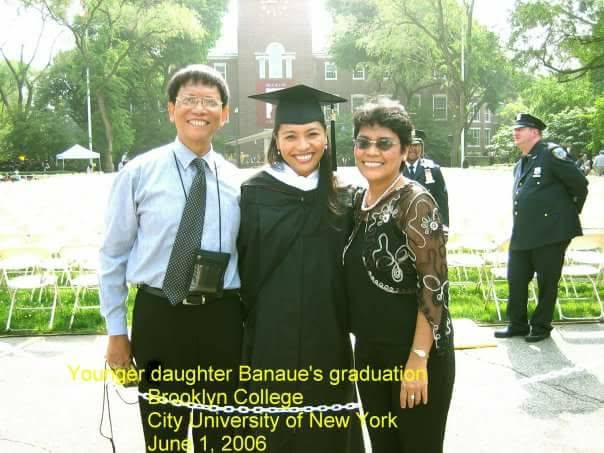
Banaue’s graduation at CUNY Brooklyn College, 2006
Banaue’s odyssey took her to New York, where she enrolled at the Brooklyn College of the City University of New York (CUNY), and took up Master of Fine Arts (MFA) in Acting. She had vocal training under Judylee Vivier, as well as master classes under F. Murray Abraham, Ruth Maleczech, Agnieszka Holland, Andrew Wade, and Vernon Morris, both of the Royal Shakespeare Company, and Dee Cannon of the Royal Academy of Dramatic Arts. She started her singing training in New York under the tutelage of Robert Carpenter, who told her that she had a voice for opera. Thus encouraged, she became a supernumerary (member of the acting chorus) at the acclaimed Met, the Metropolitan Opera in Lincoln Center, from 2006 to 2009. She then had as opera singing teacher the New York-based Philippine opera legend, Evelyn Mandac.
Banaue started her singing training in New York under the tutelage of Robert Carpenter, who told her that she had a voice for opera
In her first production at the Met, Banaue played a bear wrestler, death, and a lunatic—all in the same show. The elaborate costume changes and choreography did not faze the seasoned professional. Banaue became a supernumerary at the Met Opera for three seasons.
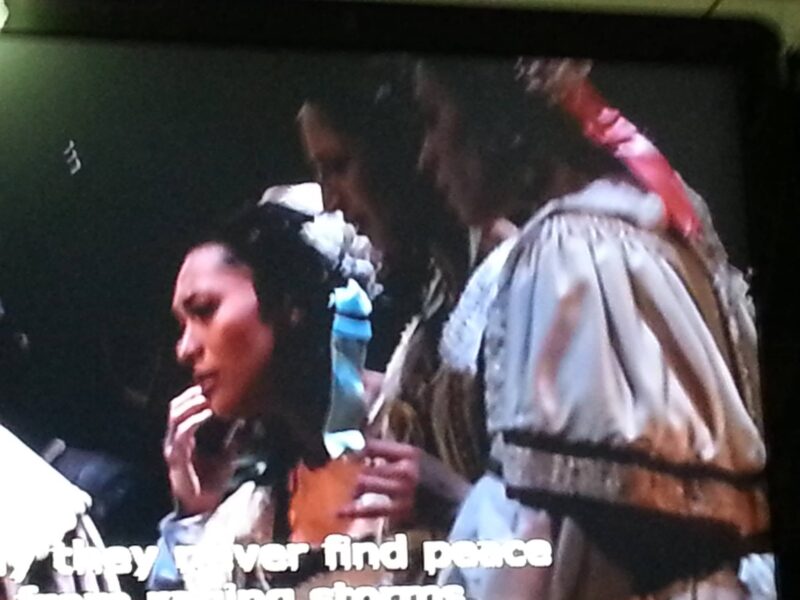
Banaue in the MET’s ‘Il Puritani’
Luce quoted Banaue as saying, “Fifty of us got into (Gounod’s) Faust, and out of the 50, three of us were selected to do other operas like La Boheme (Puccini), La Traviata (Verde), I Puritani, (Bellini), Salome (R. Strauss), and Thais (Massenet).” She became a member of the American Guild of Musical Artists (AGMA).
Luce added: “Banaue is the rare human being who seems to get 25 hours out of every day. During the past few years at the Met, she has also starred in several off-Broadway shows, maintained her rigorous study of opera, and still managed to find time to mentor aspiring actors and filmmakers at the New York Film Academy (NYFA) in the summers of 2005 and 2006.
“Cylinda Whitted, co-worker, witnessed the unique bond between Banaue and the students. ‘Banaue is a compassionate woman,’ explains Cylinda. ‘I don’t know what kind of pixie dust she sprinkled on those kids, but she was the only counselor to have student films dedicated to her.’”
While an MFA student in New York, Banaue’s membership in the Vangeline Theater boosted her talent as a dancer. She also performed as a lyric soprano in the following Vangeline Theater productions: East Meets West with Philip Glass, Memoirs of a Geisha, Tokyo Scope, C.A.R.O.U.S.E.L., Bleu, Blanc, Rouge, and Hanae Mori: A Paris-Tokyo Love Affair.
The Huffpost article continues: “Another coping mechanism for Banaue was founding the Maningning Miclat Art Foundation with her parents (and kindred friends). The non-profit foundation provides financial assistance to young aspiring artists. Banaue has headlined several fundraising performances in her sister’s honor, with the largest gala set to take place this coming September 2009.”
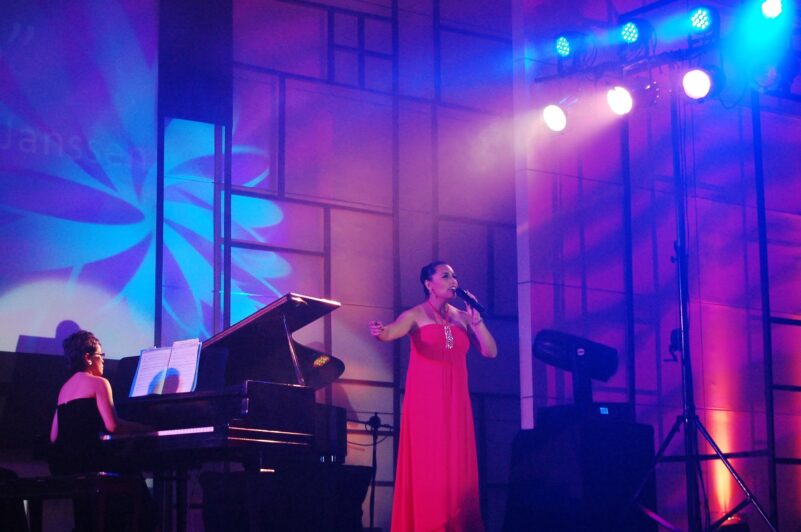
Banaue singing ‘Sunset Boulevard’ with pianist Mary Anne Espina at the 2011 Maningning Poetry Award & Concert with tenor Lemuel dela Cruz
Earlier, in April 2007, Krip Yuson, in his Philippine Star column titled “Banaue in Excelsis,” wrote about her fundraising concert with the pianist Mary Anne Espina and guest tenor Dondi Ong at the Church of the Risen Lord in UP Diliman.
Banaue in Concert: Great Painters in a Raffle showcased a performance of 13 operatic arias, kundiman, and West End theater showstoppers like Maalaala Mo Kaya by Constancio de Guzman, Puccini’s O Mio Babbino Caro, Verdi’s Saper Vorreste, and Massenet’s Gavotte sung by Banaue.
Krip wrote, “Dondi Ong sang with Banaue Verdi’s Parigi, O Cara. Then Banaue left him solo onstage, er, rather, at the altar, and Dondi thrilled us further with Nicanor Abelardo’s Bituing Marikit, then a stirring Nessun Dorma.”
Krip continued, “Banaue came back to sing Puccini’s Signore, Ascolta and Quando Me’n Vo, Johann Strauss’ Mein Herr Marquis, and Verdi’s Ave Maria, before her partner came out again for their last duet and penultimate number, er, piece: Claude-Michel Schonberg’s Last Night of the World.
“For the final cut, take, entry, rendition, cover—ahh, exaltation!—Banaue did Andrew Lloyd Webber’s Music of the Night. Her dad Mario, with whom I was competing taking digital pictures from the front pew, sidled up and whispered impishly: ‘Di ba pang-lalake ’yan?’ ‘Oo nga, naka-maskara pa.’”
Krip concluded, “But it was no phantom entertainment that night; it was real, it was live in the flesh, it was goose-pimply excellent. And the applause couldn’t have been capped by a better occasion than a raffle draw of paintings donated by artists…Egai Fernandez, Nestor Vinluan, Pablo Baens Santos, Alfredo Liongoren and Manuel Baldemor.”
“In New York,” Jim Luce further wrote, Banaue “has volunteered with my organization, Orphans International Worldwide, helping me emcee a recent event at the Harvard Club.” On that, he quoted Banaue as saying: “What I want to bring poor children, beyond food and shelter, is an appreciation for the arts. For me, art represents the soul’s salvation, especially in this materialistic world. Art helps to ground you and make you aware of the deeper connections possible with others. As Maningning taught me, art has the potential to make you a better human being… She taught me to channel pain and adversity into my work. Every time I had a difficult experience, she told me to think of it as something that will help me with my acting.”
Luce concluded: “Like her older sister, Banaue writes poetry, some of which can be found on her [now defunct] website. One particular poem spoke to me: Sculptor: ‘I tasted the salt of your sun-soaked skin/ And I thought that love is an illusion/ I stared at your unflinching brown eyes/ And I recognized the truth that’s merely a hallucination/ Till the splash of cold sea-water woke me up/ And sand sprinkled on my lips. / My eyes were blinded by the sun/ And I realized that you are the illusion.’”
Banaue would eventually come home to the Philippines for good in 2010. She relinquished the so-called US artist visa of extraordinary ability and gave back her green card at the US Embassy in Manila a few years later. She came home to take care of her father who had been in and out of the hospital due to his heart condition. She never looked back.
Banaue eventually came home to the Philippines for good in 2010, relinquishing the so-called US artist visa of extraordinary ability
In Ateneo, where she first taught after her return from the US, she played a role as Launsina, the mother of the hero in the Visayan epic Labaw Donggon, an Ateneo Entablado production directed by Jerry Respeto with libretto by Nicanor Tiongson.
She moved to UP to teach at the Department of Speech Communication and Theater Arts in 2014. She also directed plays like Linda Faigao Hall’s A Female Heart and Joshua Lim So’s Palanca Award-winning plays, Tungkol kay Angela and Nawawalang Gabi, Ninakaw na Araw. She became the Artistic Director of Dulaang UP from 2018 to 2021 upon recommendation of her mentor, National Artist Tony Mabesa.
With the constant flow of activity—teaching, mentoring, singing, directing, researching, and even marrying and giving birth to a precocious child, as she was—Banaue still longs to act, and misses the theater which became her life for decades. Her role as Lualhati in the XXI Labfest was a shot in the arm, I must say.
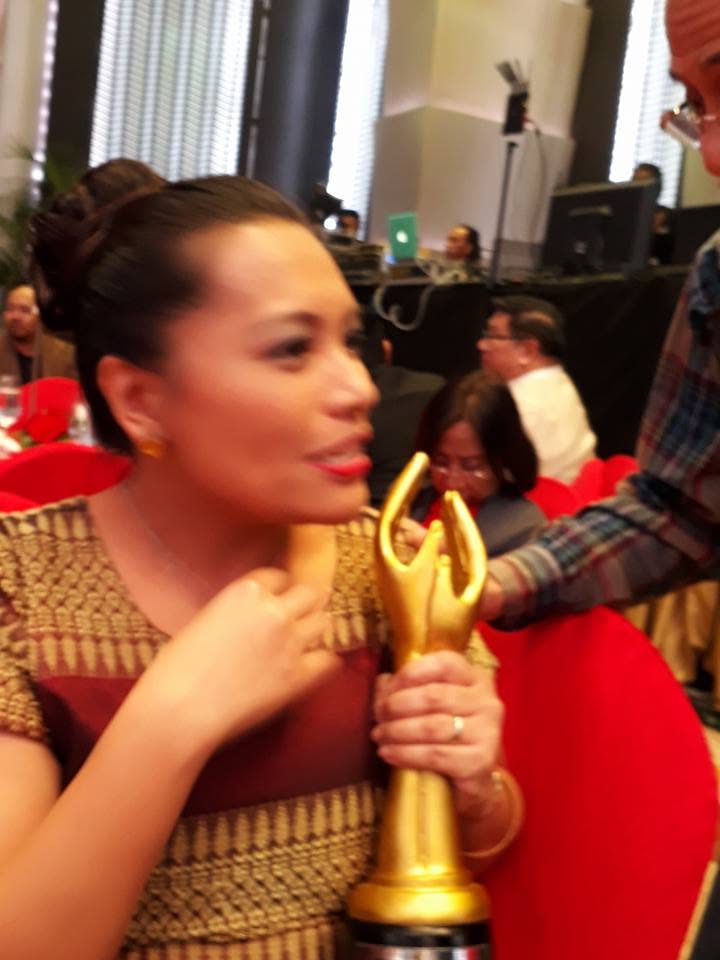
Banaue with her ALIW Award trophy
Asked which she prefers, teaching or acting, the thespian, who has been inducted into the Aliw Awards Hall of Fame, replies: “It is difficult to choose between the two because the combination balances out my overall well-being. Teaching teaches me about life, different perspectives, and various possibilities. My students refresh me all the time and keep me on my toes. Acting, on the other hand, gives me an opportunity to keep growing and reaffirming that I practice what I preach and preach what I practice. They go side-by-side.”
Alas, the little force of nature who had always played second fiddle to her precocious elder sister has been playing the lead role now, in so many ways. And the first one who must be basking in joy for her is her Ate Maningning, she who taught her to channel pain and adversity into her work, and in the process found her redemption.


