
Samsara is a collaboration with painter Tony Alcasid and sculptor Richard Buxani at the Artistspace, Ayala Museum Annex. It will run through July 26.
Tony Alcasid spent decades drifting through various careers before finally finding his grounding on the canvas. Today, his meditative geometric abstractions are capturing a new, younger generation of collectors.
At the turn of the millennium, Alcasid found himself at a crossroads. He was in his 40s and drifting between careers, having spent years taking on various jobs after studying business administration at the University of the Philippines.
Although he had dabbled in painting as a hobby while pursuing his MBA at the University of Southern California in the early 1980s, soaking in the vibrant Hollywood art and design scene, art had remained in the background.
Coming home to the Philippines, he spent time in Indonesia working for his father’s rattan furniture venture, but when the business folded, he returned to Manila. He helped his brother, the popular singer and songwriter Ogie Alcasid, then at the peak of his showbiz career, and worked for his family’s rural bank in Taal, Batangas.
During this period of midlife crisis, Alcasid found grounding in faith. He became deeply active in his parish, serving and singing in the church. It was his return to his musical roots as a member of the very first batch of Kundirana, the famed La Salle Greenhills high school music ministry turned performing arts group. Hanging out with Born-Again Christian friends and participating in Bible study groups made him more conscious of his spirituality, a shift that would eventually define the themes of his creative life.
His formal entry into the art world happened almost by accident 25 years ago. While sipping coffee at the Rico Renzo Gallery and Café at LRI Plaza, Alcasid spotted a poster advertising a six-month art workshop taught by Gerry Ingco. When the teacher asked what he wanted to learn, Alcasid replied that he wanted to paint abstracts. The workshop culminated in an invitation to a group show, launching a steady path of solo and collaborative exhibitions.
Though his art practice stalled, Alcasid returned to the canvas during the pandemic lockdowns. The return proved to be a rebirth. Following a post-pandemic solo show, Alcasid partnered with the team behind the now-closed Rico Renzo Gallery to revive the venture as Rico Renzo Arts Management. Operating without the burden of a permanent physical gallery, the group now organizes nomadic exhibitions wherever they can. This proves that for Alcasid, art and faith are no longer just hobbies, but a way of life.
His latest exhibit at the Artistspace is titled Samsara, a Sanskrit word referring to the cycle of birth and rebirth. After years of being influenced by other artists in collaborative shows, he is now finding his voice. This collection explores his identity and what it means to be Asian.
He chose an Indian title because Indian culture is in the roots of Southeast Asian culture, including that of the Philippines. Alcasid noted that Filipinos were once part of these ancient empires. He realized this historical connection while living in Indonesia, where he saw how proudly people embraced their heritage.
His new works reflect a mix of these regional influences, including Chinese elements. His grid paintings are his interpretation of ethnic patterns, which he developed by studying a book of traditional Filipino designs.
These abstractions carry spiritual titles such as Nirvana, meaning bliss, and Moksha, meaning liberation. The pieces are defined by bold colors, soft pastels, metallic tones, and geometric arrangements of squares and circles.
To create the textured grids, he sourced textured paper online, cut it up, and collaged it with vintage maps and letters. He also applied a verdigris technique that he learned during his furniture-making days. In painting, verdigris is a technique that mimics the natural green or bluish-green crust that forms on oxidized copper and bronze over time. This process gives the surfaces of his collages the weathered look of rusted metal.
‘Double Happiness’
‘Marantha’
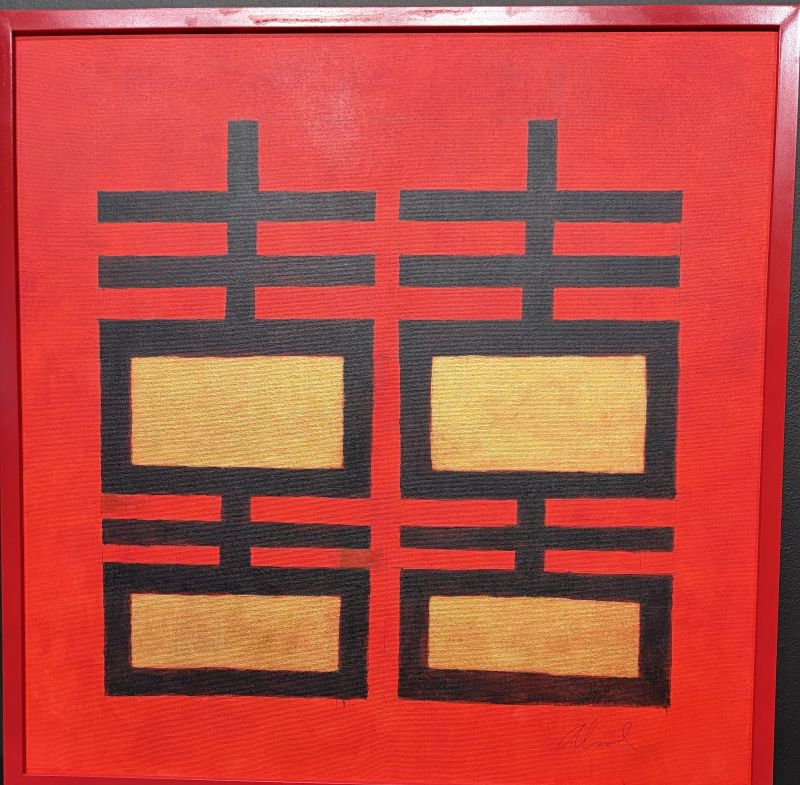
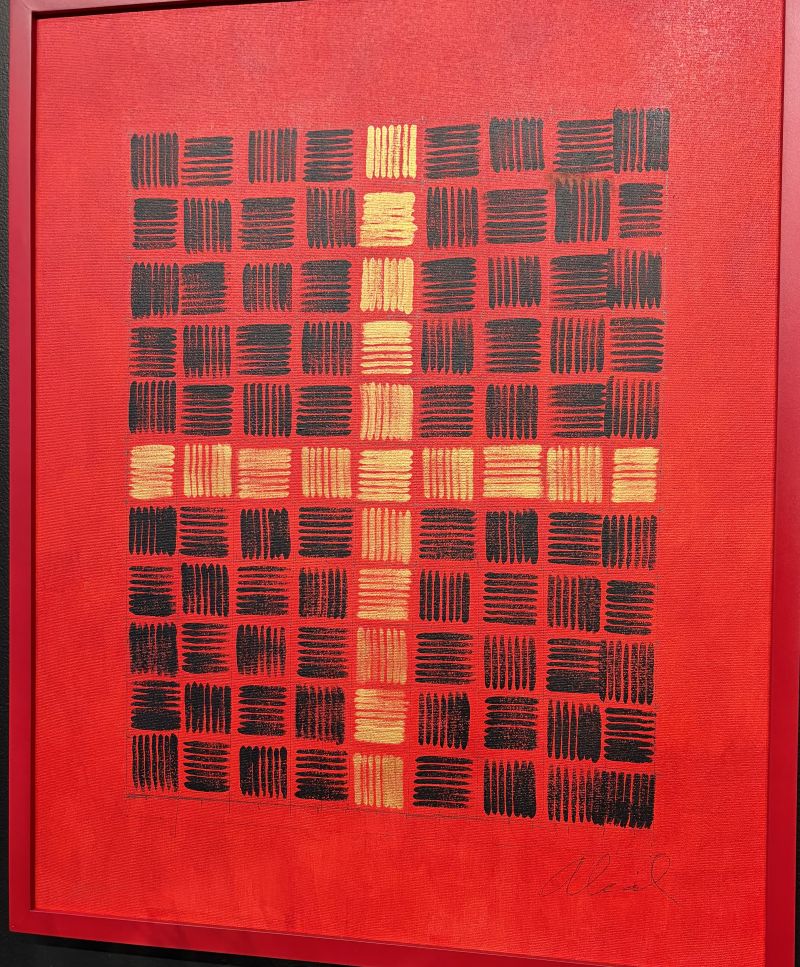
Alcasid restricts his palette to red, black, and gold to strip traditional symbols down to their graphic essentials. In Double Happiness, the Chinese character for marital union is rebuilt with heavy black lines framing gold rectangles. Its companion piece, Marantha, replaces this bold geometry with a woven grid of fine, repetitive lines, a gold cross emerging at the center as a point of spiritual reflection.
‘The Four Seasons’
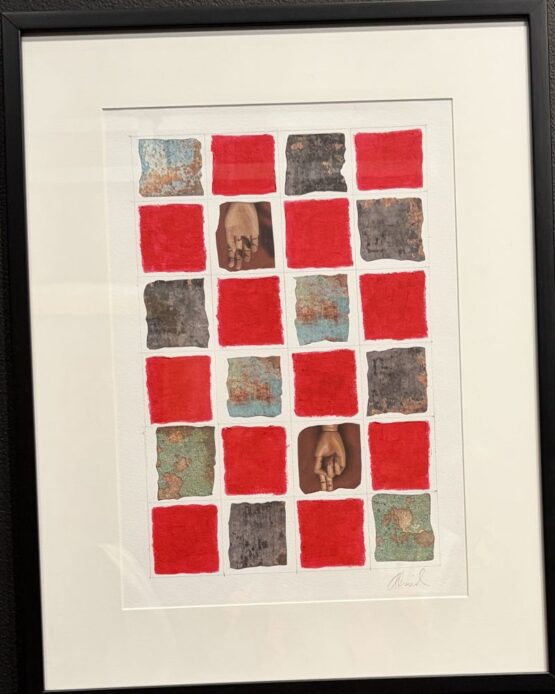
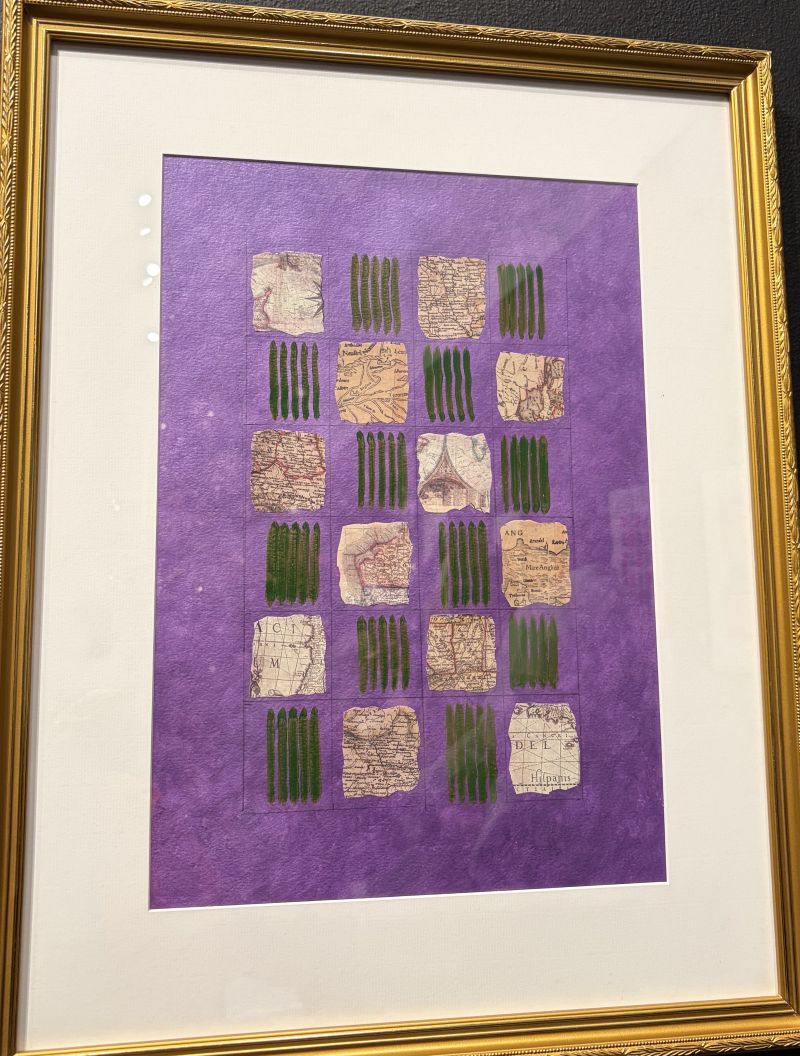
He uses the structure of the checkerboard grid to explore contrasting textures and materials. In Mudra Quadryptych 2, the artist contrasts flat, vibrant red squares with rough, distressed panels that mimic weathered concrete and oxidized copper, creating a gritty, industrial feel that frames two realistic images of wooden mannequin hands. The Four Seasons alternates vintage map fragments with green strokes resembling blades of grass against a fibrous purple background. By pairing these organic elements with the geometric grid, Alcasid softens the structure to create a subtle, tactile contrast.
In a separate work of concentric circles, the artist abandons the rigid grid entirely in favor of organic movement. Hand-drawn golden rings ripple outward against a textured black backdrop like tree rings, drawing the eye to a single red dot at the center. This dot serves as visual anchor, grounding the golden rings and lending the work a meditative quality. By pairing these loose, hand-drawn lines with stark color contrasts, Alcasid strikes a balance between ancient wisdom and modernity
Alcasid is now building a steady following of collectors, with new clients discovering his work each year. At the opening of Samsara, the crowd was notably young. His brother, Ogie, spent the evening speaking with these younger patrons, who found themselves drawn to the paintings. Alcasid believes that abstraction naturally resonates with a newer generation of art lovers.
His path to this style was not entirely direct. At one point, Alcasid felt the need to prove his technical skills through realism. He worked in oil to paint seascapes, buildings, and a large-scale rendering of Angkor Wat from a trip to Cambodia. Yet he eventually returned to abstract art, finding realism too focused on physical reality.
For Alcasid, abstraction remains the truest vehicle for his self-expression. He views the shift as a form of soul-searching that ultimately led him to his authentic self. He believes that an artist can only produce his best work by being true to who one is, creating pieces that viewers can instantly recognize as uniquely his.
‘Samsara’ is a collaboration betwen painter Tony Alcasid and sculptor Richard Buxani at the Artistspace, Ayala Museum Annex. It will run through July 26.


