

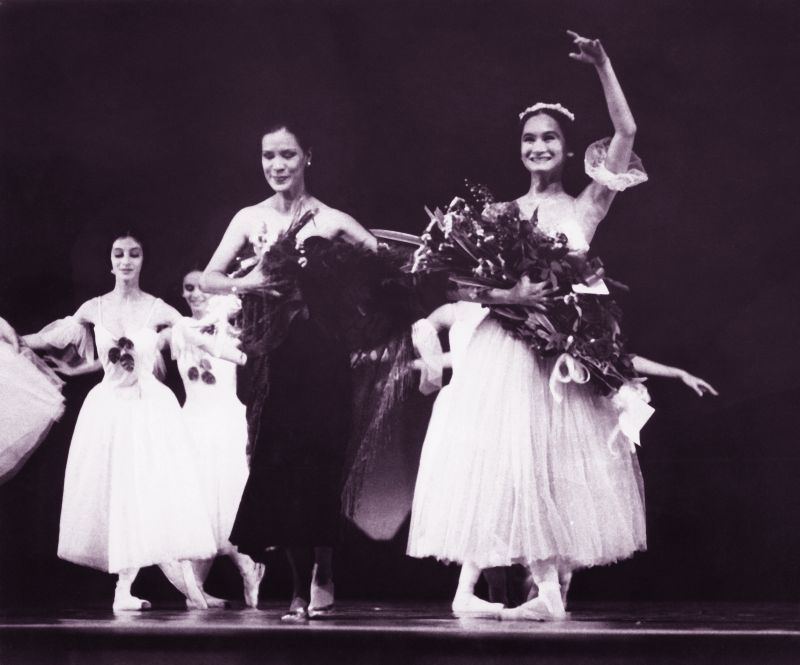
Lisa Macuja (right), as Giselle, takes a bow with Tita Radaic in Dance Theater Philippines’ 20th anniversary show. (Contributed photo)
A pillar of Philippine dance, Felicitas “Tita” Layag Radaic (pronounced Rah-dy-eoh), took her final bow on June 2 after a lingering illness. She was 89.
Baby boomers and Gen-Xers in the dance community remember her as an educator, visionary, and tireless advocate for ballet. Her greatest contribution was raising standards in dance education and technical training. In 1968, she established the Philippine Center of the Royal Academy of Dance (RAD), introducing one of the world’s most widely adopted ballet training systems to the country. For generations of parents seeking graceful deportment and disciplined training for their daughters, the St. Theresa’s College (STC) School of Dance in Quezon City became the destination of choice.
Tita’s students were known for their distinctly English style, marked by elegance, precise footwork, clean lines, and lyricism. Her teaching emphasized grace and clarity over athletic virtuosity. The approach mirrored her own dancing. Giselle, with its delicate footwork, suspended movement, and flowing arms, was among her favorite roles.
In the early 1990s, she formed and led the RAD Registered Teachers Association of the Philippines, recognized by RAD headquarters in London. Under her leadership, the organization mounted productions that brought together schools teaching the RAD method. The largest was the Dance Drama of the Life of St. Therese of the Child Jesus, staged at Mount Carmel Church in 1997 to mark the saint’s centennial. Supported by the Carmelite Nuns of Hemady, the production was presented free to the public and later aired as Lenten special on PTV 4 for two seasons.
A teaching grant to the Beijing Dance Academy in 1993 proved pivotal. Drawing on the RAD’s systematic approach and the training methods she observed in China, she developed the Philippine Classical Ballet Syllabus. Her goal was to make quality ballet education accessible at a time when RAD examination fees were costly. The syllabus, now in its second edition, received support from the National Commission for Culture and the Arts and was co-authored by educators Vella Damian (an alumnus of St. Theresa’s) and Noordin Jumalon.
To showcase dancers trained under the RAD system, she founded Dance Theater Philippines (DTP), the semi-professional company of the STC School of Dance. Tita handled much of its administration and networking. In 1987, she also became one of the founding members of Philippine Ballet Theatre, which sought residency at Cultural Center of the Philippines.
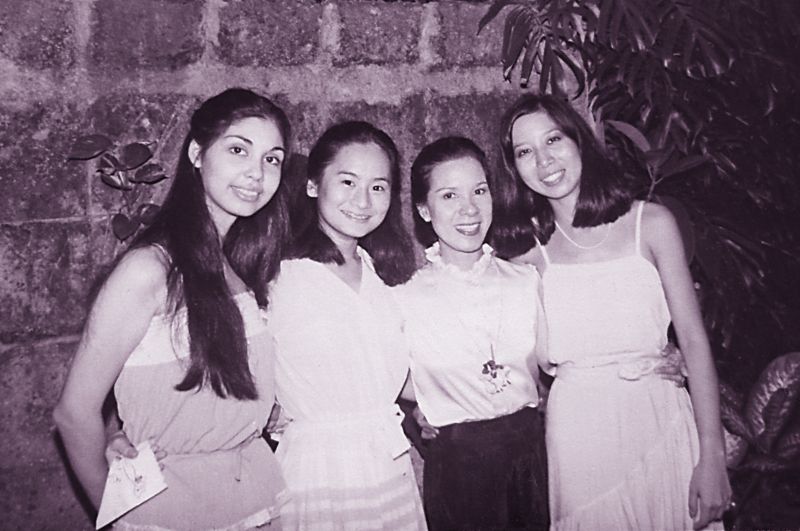
Tita Radaic (second from right) with young ballerinas Sofia (Vinki) Radaic, Lisa Macuja, and Mary Ann Santamaria
Ballet educator Sonia Domingo studied under Tita before moving to London, where she also trained with Ruth French. “Tita’s teaching style emphasized fast footwork, petit allegro, influenced by her training in London,” says Sonia.
Upon returning to the Philippines, Sonia assisted artistic director Basilio Esteban “Steve” Villaruz in running DTP. When the company later moved to the University of the Philippines, it gradually evolved into the UP Dance Company. Tita also appointed Sonia to organize RAD examinations from 1990 to 1998 before the responsibility shifted to the British Council.
Sonia learned from Tita a deep passion for precision and an uncompromising approach to technique. “You don’t allow shortcuts,” she says, describing a very British discipline.
Ballet Manila chief executive officer and artistic director Lisa Macuja Elizalde remembers Tita as one of the defining influences of her youth at STC and DTP.
As a child, Lisa first encountered Tita through older students who described their mentor as a terror, a term often reserved for strict disciplinarians. By the time Lisa studied under her as a tween, she understood why.
“I was a precocious, energetic kid. I was flexible and I relied on that flexibility to get through ballet class. I was kiti-kiti (restless),” she says. Whenever Lisa’s hips swayed slightly during a grand plié, Tita noticed. “She told me, ‘You are better off as a Hawaiian dancer.’”
On another occasion, Lisa was hanging on the barre when Tita entered the studio. “Don’t hang on the barre. You look like a monkey,” she said. Yet, Lisa also managed to secure her first solo with a bit of youthful audacity: “Ms. Radaic, you told me to remind you about making a solo for me in the recital.” Tita obliged.
One lesson stayed with Lisa throughout her career. Tita emphasized the importance of lengthening the torso to achieve a regal posture, using the word hagod, meaning to lengthen.
“I remember she held me by the waist and pulled me up,” Lisa says. “She made me do it with my heels off the floor.” Tita kept her hands steady at Lisa’s waist, ensuring the torso stayed lifted even as Lisa slowly lowered her heels back to the floor. It’s a method she still imparts to her students to look taller.
She also remembers being in awe of her teacher as she performed in The Prey, wearing a red-draped costume and arching her body dramatically across the stage. As a young student, Lisa also admired Vinki’s chiseled features, the ideal dancer’s physique and lyricism.
She was disappointed when she was not included in a delegation to the Asian Arts Festival in Hong Kong because the choreography was intended for older dancers. The following year, however, she joined DTP’s trip to the Aberdeen International Youth Festival in Scotland.
During her years with DTP, Lisa was cast in substantial roles, such as the comic role of Aling Tali in Tita’s Tanan, danced George Balanchine’s Tarantella with guest artist Enrico Labayen, and appeared in the original cast of Tony Fabella’s Limang Dipa.
Tita constantly sought new audiences for ballet. Through Teodoro Valencia, chairman of the National Parks Development Committee, she launched Ballet at the Park at the Luneta Open-Air Auditorium. Ballet at the Park initially drew curious hoi polloi who hollered and hooted when ballerinas appeared in short tutus and performed movements that inadvertently revealed their crotches. Over time, however, audiences grew more appreciative and developed a better understanding of the art form.
That experience shaped Lisa’s own philosophy. “This memory of how ballet can educate inspired me to make Ballet Manila accessible to the people,” she says.
Tita’s most significant influence came when Lisa faced a life-changing decision. She had been accepted to the San Francisco Ballet School, received a scholarship to the Vaganova Academy of Russian Ballet in St. Petersburg, and faced pressure from relatives who wanted her to pursue a conventional profession. She had also passed the entrance examinations for both UP and Ateneo.
Tita wrote a letter to Lisa’s father, arguing that the country already had enough accountants and too few ballerinas. Lisa went on to become the first Filipina soloist of the Mariinsky Ballet before returning home to build a career that transformed Philippine ballet.
When Lisa Macuja’s family wanted her to pursue a conventional profession, Tita wrote to Lisa’s father, telling him the country had enough accountants and too few ballerinas
As a student, Hazel Sabas divided her time among volleyball, glee club, and ballet. One day she arrived in class looking rumpled, prompting Tita to tell her that she had too many distractions.

Sofia Radaic Jellic and Hazel Sabas
“That was when I realized the seriousness of the art and the importance of focus in ballet training,” says Sabas. “I began to fall in love with ballet when I discovered it could be a platform for self-expression.”
One piece of advice stayed with her: “Success is 99 percent hard work and one percent talent,” Tita would say.
As DTP member, Sabas deepened her appreciation for dance through camaraderie during rehearsals, performances, and international tours. The experience cemented her decision to pursue dance professionally.
Sabas became principal dancer with Ballet Philippines, artistic director of Ballet Lubbock, ballet mistress of Ballet Memphis, and professor at several American universities. Today, she serves as judge at international ballet competitions.
“I was totally smitten by this beautiful art form that Mrs. Radaic opened up for me,” says Hazel. “She taught from the heart. She had a gift for passing on the joy of dance to her students.”

Malen Claravall and Tita Radaic in Antipolo
Dance educator Marilinda “Malen” Claravall has known Tita for six decades, beginning at age 14 as her teaching assistant at STC.
“She was very strict and frank, but underneath the stern facade was a soft side,” says Malen. “She became a mother hen to RAD teachers. She worked hard to secure dance scholarships through embassies. I learned patience, how to teach, and how to trust the process.”
Their relationship deepened after Malen was widowed at 39 in 1993. Tita advised her not to remarry and instead focus on raising her children. The two women spent time together discussing history, books, and life. “I was like her second daughter,” says Malen.
When Tita moved to Antipolo, Malen sometimes would sleep over in her hillside home.
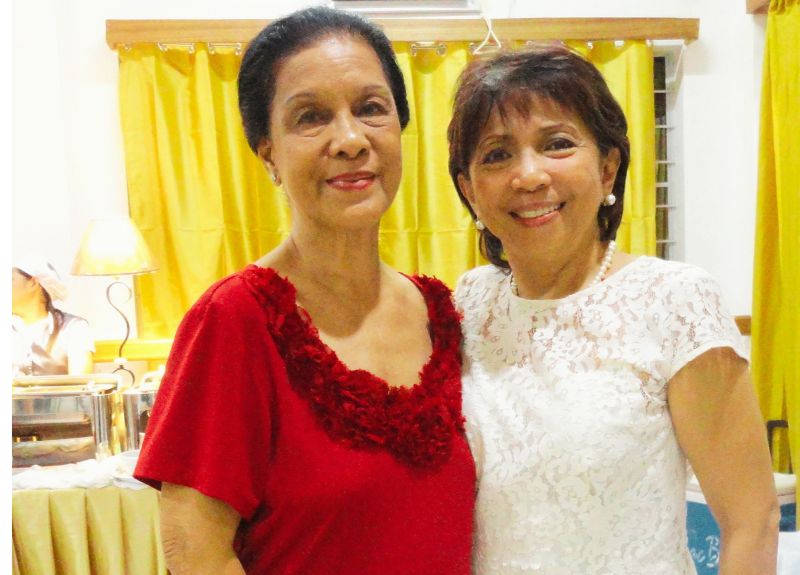
Tita Radaic with Malen Claravall
In 2009, Malen joined the Artistic Council of Philippine Ballet Theatre upon Tita’s recommendation. “She guided me in learning how to help run a professional dance company,” says Malen. “She always said, ‘All your decisions must be supported by contracts or memoranda of agreement. Document everything down to the last centavo.’”
When Malen became executive director in 2010, Tita helped her recruit board members, plan productions, and cultivate patrons and sponsors. “She was truly a stand-alone leader,” Malen says. “She could unite people behind one direction and one purpose.”
During the last decade of her life, Tita faced a series of health challenges. Yet she remained mentally sharp and continued exercising at home. Since 2017, Vinki spent increasing amounts of time in Antipolo caring for her mother.
In her final hours, Malen and Vinki were at Tita’s side. They lit candles and prayed the rosary as she slipped away quietly. It was a fitting farewell for a woman who had spent a lifetime instilling discipline and grace. In death, as in life, Tita remained every inch the ballerina.


