
Several statistical milestones marked this year’s Gawad Buhay, the annual awards for theater handed out by Philstage to celebrate the best achievements among its member companies’ productions staged the previous year.
In the 16th ceremonies held July 28, 2026 at Aliw Theater, Pasay City, Tanghalang Pilipino’s (TP) Kisapmata became the first in the awards history to make a clean sweep of the production, direction, writing, ensemble performance, and all four individual acting categories.
Only two other productions had swept the individual acting awards, but neither won for ensemble performance. Repertory Philippines’ (Rep) Sweeney Todd dominated the musical acting categories in the 2nd Gawad Buhay, with Audie Gemora and Menchu Lauchengco-Yulo taking the trophies for lead performance, and Marvin Ong and Liesl Batucan winning for featured performance. The ensemble award for a musical was shared by Ismail at Isabel and Si Juan Tamad, ang Diyablo, at ang Limang Milyong Boto, both staged by Philippine Educational Theater Association (PETA).
In the fifth ceremonies three years later, PETA’s Bona—adapted by Layeta Bucoy from the 1980 Lino Brocka classic—saw the acting quartet of Eugene Domingo, Edgar Allan Guzman, Olive Nieto, and Juliene Mendoza snagging their first Gawad Buhays; Outstanding Ensemble Performance for a Play went to TP’s Walang Kukurap, also penned by Bucoy.
Two of Kisapmata’s designers also set records. Joey Mendoza nabbed his third trophy for set design—having won for Rep’s Agnes of God and Barefoot Theatre Collaborative’s The Last Five Years—and now ties Mio Infante’s trophy haul in that category. Infante was honored for Trumpets’ The Bluebird of Happiness, PETA’s Rak of Aegis, and 9 Works Theatrical’s American Idiot.

Arvy Dimaculangan accepting his third Gawad Buhay for sound design (Photo by Vincen Gregory Yu)
Likewise, Arvy Dimaculangan—a previous winner for The Sandbox Collective’s Every Brilliant Thing and TP’s Nekropolis—bagged his third trophy for sound design, matching Jethro Joaquin’s record. Joaquin’s wins were all for Rep productions: Hamlet, Equus, and Agnes of God; only TJ Ramos has more, with four, for Ballet Philippines’ Encantada, and TP’s Stageshow, Der Kaufmann: Ang Negosyante ng Venecia, and Mabining Mandirigma.
Kisapmata also earned the multi-hyphenate Guelan Varela-Luarca two new Gawad Buhays—one for directing, another for writing—complementing his previous wins for directing TP’s Batang Mujahideen and writing the scripts of Coriolano and Nekropolis for the same company. This year, Varela-Luarca shared the victory for Outstanding Translation or Adaptation with the TP Actors Company (AC), who co-devised the critically acclaimed screen-to-stage transposition of Mike de Leon’s 1981 film about a household seemingly unable to escape the authoritarian spell of its ex-cop patriarch.
Varela-Luarca’s double win that night also made him the third person in awards history to be recognized for directing and writing the same work: His predecessors are Rody Vera, who refashioned Rolando Tinio’s Filipino translation of Shakespeare’s The Merchant of Venice into Der Kaufmann, and co-directed that TP production with Tuxqs Rutaquio in 2013; and Chris Millado, who directed Balete for TP and devised the script with Vera, dramaturge Sabrina Basilio, choreographer Delphine Buencamino, and the TP AC in 2024.
For musicals, Pat Valera won for his book and direction of Dekada ’70—based on Lualhati Bautista’s novel—in the 13th ceremonies, while sharing Outstanding Original Score with William Elvin Manzano for a different work: Mula sa Buwan.
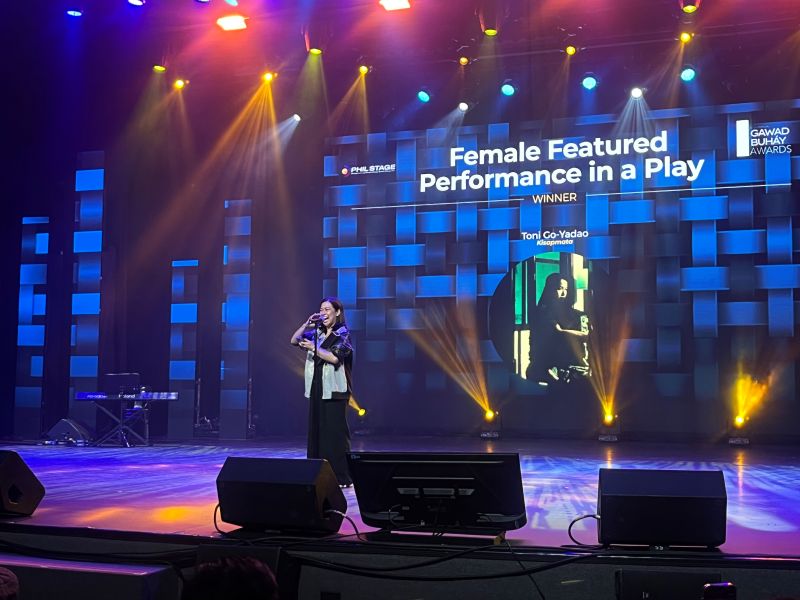
Kisapmata’s four-person cast consisted of the senior TP AC members affectionately referred to as the “fearsome foursome.” Playing the pregnant daughter Mila, Toni Go-Yadao won her second consecutive Female Featured Performance in a Play award, having won last year for Balete. She also became the first actress to win the category twice.
Marco Viaña, who essayed the role of Mila’s fiancé, was similarly a back-to-back winner for Male Featured Performance in a Play, having won that category last year for Balete. Counting his first trophy for TP’s Ang Pag-uusig—Jerry Respeto’s Filipino translation of Arthur Miller’s The Crucible—Viaña is now the most awarded actor in that category. Most notably, this latest accomplishment marked his fifth trophy overall—he also won Male Lead Performance in a Play for TP’s Katsuri in the 12th ceremonies, and shared Outstanding Costume Design with Paw Castillo for TP’s Sandosenang Sapatos in the 14th.
Thanks to Kisapmata, Viaña and Varela-Luarca now belong to an elite company of theater artists—alongside Millado, Ramos, and lighting designer John Batalla—with five competitive Gawad Buhays. Only four others have more: Vera remains the record holder with 11 trophies, while Vincent de Jesus, Cris Villonco, and Myke Salomon have six apiece. Salomon won his sixth trophy this year for his musical direction of Barefoot’s We Aren’t Kids Anymore—an honor he shared with first-time nominee and winner Farley Asuncion—and is the most awarded person in that category, having previously triumphed for the jukebox musicals Rak of Aegis, 3 Stars and a Sun, and Ang Huling El Bimbo.
Inarguably, the most meaningful win of the night belonged to Jonathan Tadioan, who took home Male Lead Performance in a Play for portraying Kisapmata’s tyrannical patriarch Dadong. Tadioan’s win was long overdue: This was already his 14th acting nomination and 15th overall (he was nominated two years ago for directing Sandosenang Sapatos). No other individual had amassed as many nominations without winning. Think Peter O’Toole and Glenn Close at the Oscars.
Tadioan’s nominations also represented nearly two decades of consistently acclaimed work with TP and the Cultural Center of the Philippines. His first for lead actor was for the Virgin Labfest play Pamantasang Hirang, back when the festival entries were still considered for the awards during the 1st ceremonies. The 13 other acting nominations that followed included his convincing turn—at 29 years old!—as Arthur Miller’s 63-year-old Willy Loman in Death of a Salesman, now Pahimakas sa Isang Ahente by Tinio, in 2014; and Mitch in Flores Para Los Muertos—Tennessee Williams’ A Streetcar Named Desire in Filipino—in 2009.
How anti-climactic, then, that Tadioan wasn’t physically present for his much-awaited victory
How anti-climactic, then, that Tadioan wasn’t physically present for his much-awaited victory—made even sweeter by the fact that he won alongside his wife, Lhorvie Nuevo-Tadioan, who took home Outstanding Lead Actress in a Play (and her second trophy overall, following her featured turn in Batang Mujahideen).
Yet, this absence was also an apt reminder of what the filmmaker David Fincher once said: Awards are just icing on the cake. It’s the work—in other words, creating meaningful art—that matters more.
Related Stories:
Master Class: Menchu Lauchengco-Yulo has us in the palm of her hands
miZZcast: Concert as massive, glorious karaoke session
Yemaya: Ravishing and intelligent
Virgin Labfest 21: Best play—’Elehiya’ by Dustin Celestino
Man of La Mancha: Nelsito Gomez assembles one of most intelligent cast performances of 2026
Among TP’s fearsome foursome, only Go-Yadao was present during awards night; the Tadioan couple and Viaña, with Varela-Luarca, were in Yogyakarta, Indonesia, representing the Philippines in the 2026 Asian Playwrights Meeting. Numerous representatives thus took turns trooping to the stage to accept Kisapmata’s 11 wins—the most by any production—though Tadioan still managed to “personally” accept his award via live phone call.
“Magkita-kita tayo lahat diyan pagbalik namin!” Tadioan said, his voice filtering through a phone held to the microphone by TP production manager Chi Navarra.
In a way, the highly informal manner in which Tadioan accepted his award was entirely in keeping with the atmosphere Gawad Buhay has cultivated over the years. Writing on Facebook two years ago, critic and founding awards juror Gibbs Cadiz mused that, while he once imagined Gawad Buhay to be “like the Tonys, where theater people dressed up and came in their glitzy best on the biggest night in their honor,” he now completely understood “the laidback, chummy, casual vibe that has come to define” awards night, which is “more in line with the spirit of community and camaraderie—more than competition”—that Gawad Buhay has “aimed for from the beginning.”
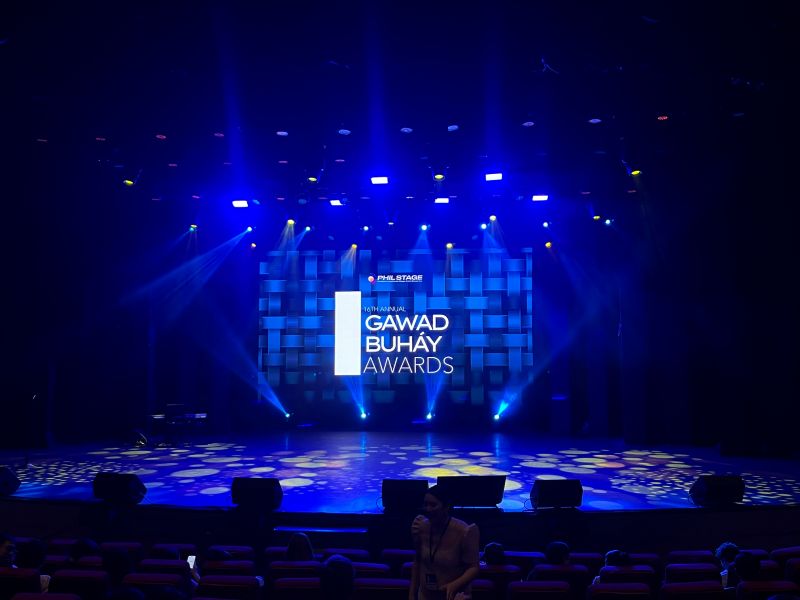
Stage of the Aliw Theater for the 16th Gawad Buhay Awards (Photo by Vincen Gregory Yu)
Indeed, this year’s ceremonies felt closer to a chill homecoming than to those fancy, splashy televised awards shows, though a humble red carpet still welcomed attendees who braved the monsoon rains and flooded streets of Metro Manila. (To this end, I must say the Aliw Theater felt too cavernous for this ersatz homecoming, with the attendees scattered all over; I much preferred the more compact offerings of, say, the PETA Theater Center from the 2023 ceremonies.)
The evening’s most memorable segments likewise unfolded with a similar mood. Topper Fabregas, who played the iconic Donkey in Full House Theater Company’s Shrek the Musical and won Male Featured Performance in a Musical, was visibly surprised that he won, a bewildered expression stuck to his face the entire time he made his way to the stage.
Shiela Valderrama, Gawad Buhay winner for Philippine Opera Company’s Passion, and her daughter Simone were both in terrific voice as they sang Barbra Streisand and Judy Garland’s famous mash-up of Get Happy and Happy Days Are Here Again.
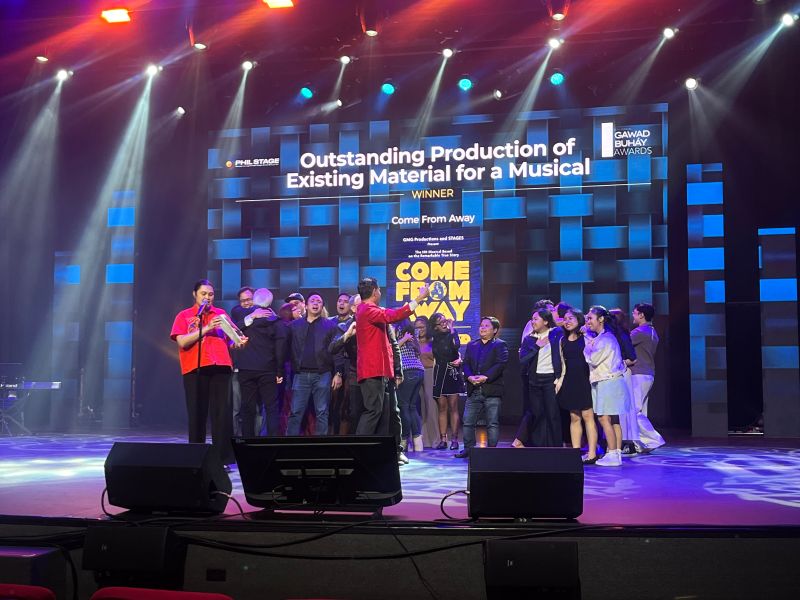
Sam Sewell (left) and the ‘Come From Away’ team (Photo by Vincen Gregory Yu)
“What else does one say except for… what the f*ck?” said Sam Sewell, who evidently did not expect to find herself onstage accepting the final award of the night—Outstanding Production of Existing Material for a Musical—for Come From Away, which GMG Productions co-produced with Stages Production Specialists, Inc.
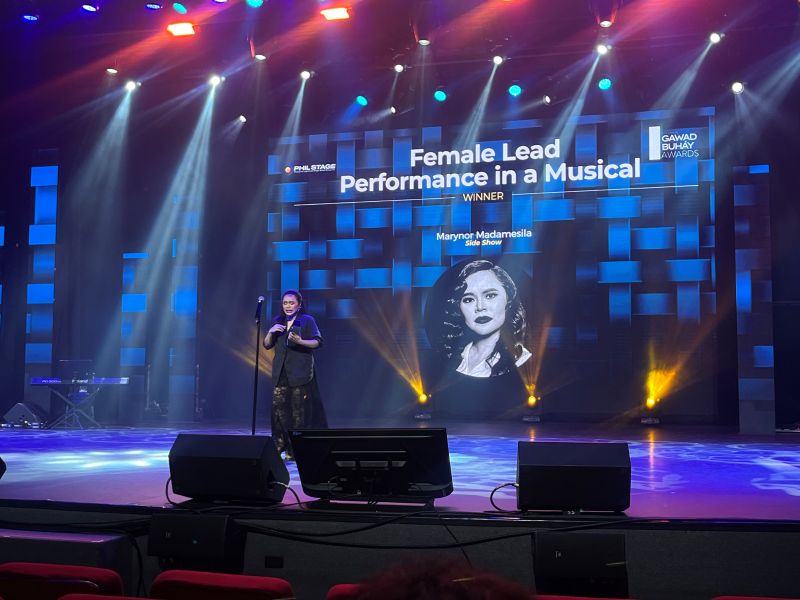
A visibly emotional Marynor Madamesila accepting her Gawad Buhay (Photo by Vincen Gregory Yu)
And without a doubt, Marynor Madamesila delivered both the funniest and most heartfelt speech of the night—an all-timer, in my opinion—after winning Female Lead Performance in a Musical as one of the Siamese twins of Sandbox’s Side Show.
“Sabi ko kanina, dahil I’m ‘neurospicy’ and mentally ill and sleepless, isipin ko na lang na panalo na ako, so kung sino mananalo, panalo ako with her—tapos nanalo ako!” Madamesila said, alternating between overwhelmed, panicked, hilariously self-aware, and genuinely emotional and grateful. She went on to thank her mother—a “stage mom pro-max” who once took out a prayer book backstage to calm her down during a pre-performance panic attack—and expressed her hope for theater to enjoy the same scale and vitality it has in Manila in places beyond the capital region, reaching “the grassroots and the little kids.”
But the most consequential parts came early in the night. First, PETA executive director Anj Heruela delivered Philstage’s annual report, where she revealed that the last two years have actually witnessed a steady uptick in the number of individual performances staged by member companies since the industry’s post-COVID reopening—from 325 performances among 26 productions in 2023 to 717 performances among 28 productions in 2025. These shows also “reached” 235,452 audiences in 2025—a 23 percent increase from 2023’s 190,048, according to a graphic from that presentation.
After discussing these statistics, Heruela asserted the need to continually refine the systems in the theater industry, not least by ratifying a code of ethics and establishing a review and classification board.
“Professionalization is not the enemy of art, but what makes it viable and sustainable” Heruela said. It is how “we protect our artists” and how “we protect our productions.”
A bit later came the presentation of Outstanding Original Score—one of 28 competitive awards up for grabs. That category had only two nominees: The Necessary Theatre and WHYNot Manila’s production of David Hare’s Via Dolorosa, set to haunting, evocative music by Gabby Ramos (on oud, Nigerian udu, guitar, kalimba, and sampler) and Dexter Lansang (on cello); and TP’s original Pinay Pop musical Gregoria Lakambini, composed by Nica del Rosario and Matthew Chang, who also penned the lyrics with book writers Eljay Castro Deldoc and Nicanor Tiongson.
Gregoria was a deserving winner, if only for giving the world that gorgeous romantic earworm Buwan, Buwan (available on Spotify). But Chang’s acceptance speech—brief and breathless—was the subtext-laden jolt of electricity the room likely didn’t see coming.
“Hindi tayo kayang tapatan o palitan ng kahit anumang AI (artificial intelligence),” Chang declared, to rapturous cheers and applause.
At any other time, Chang’s words could have been just another impassioned affirmation of the artistic spirit; an urgent call to action to safeguard the fragile, human dimension of art against the rampant, irresponsible use of AI; and a plea to reverse what lately feels like the inevitable dumbing down of an entire civilization.
But this wasn’t any other time: Chang’s speech was, one can safely presume, directly in response to—and in support of—the industry-breaking article by TheaterFansManila.com managing editor Frida Tan regarding “authorship, attribution, and the future of Philippine musicals,” to quote the title.
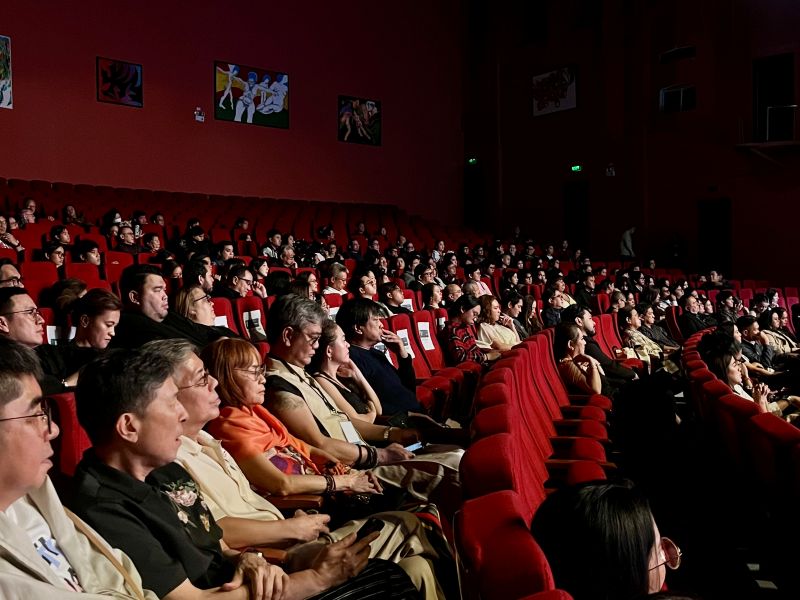
View of the theater at the 16th Gawad Buhay Awards (Photo by Vincen Gregory Yu)
Published only two days before awards night, Tan’s article investigated the murky authorship of Tulog Na: The Musical by Studio A Productions (not a Philstage member company, it should be clarified). Or, to be more precise, what appears to be its non-authorship; no composer or lyricist has been publicly identified and credited by the company, when these individuals should be “inseparable from the identity of the musical itself.”
Initially claiming it was composed by “an in-house creative team,” Studio A later told Tan that a certain JR Dee is supposedly behind the music and lyrics of Tulog Na. Since then, the company has been vague and non-responsive to further questions, including to Tan’s request to profile Dee—whom no one in the theater community seemed to know, and curiously had no digital footprint as far as a “publicly documented artistic background” is concerned.
To go by the lengthy discussions on Facebook and Reddit, the article has ignited suspicions that AI may have possibly played a role in the creation of Tulog Na, which was a sold-out play before becoming a musical (and about to star the comedian Pokwang, no less). Chang himself was interviewed by Tan, pointing out that the very absence of a public credit for a composer naturally “raises questions about authorship and creative transparency.”
Tan’s razor-sharp concluding points are well worth reiterating and reprinting: “If we stop asking who wrote the music and lyrics…we lose the ability to recognize the human beings behind the work and the creative labor they have given to it. At a time when our creative industries are being reshaped by technology, preserving that humanity is more important than ever. Every musical should have a human being attached to its music and lyrics, not just privately, but publicly.”
Empasis on “reshaped by technology,” I might add, capped off with a knowing, frustrated wink.
So far, the suspicions regarding AI use have remained on the discussion boards, with noticeably few theater artists being vocal on the matter. The article shares and reactions, however—especially from many artists themselves—suggest that louder and more heated conversations might be taking place far beyond what is perceptible to general observers. If anything, Chang’s speech only brought those conversations into as large and public a space as possible, at precisely the right time.
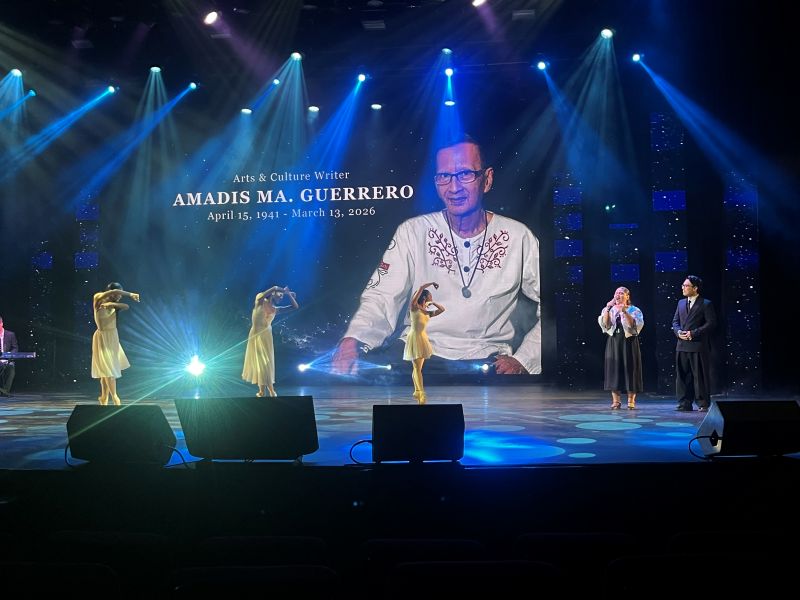
In memoriam tribute to journalist Amadis Ma. Guerrero (Photo by Vincen Gregory Yu)
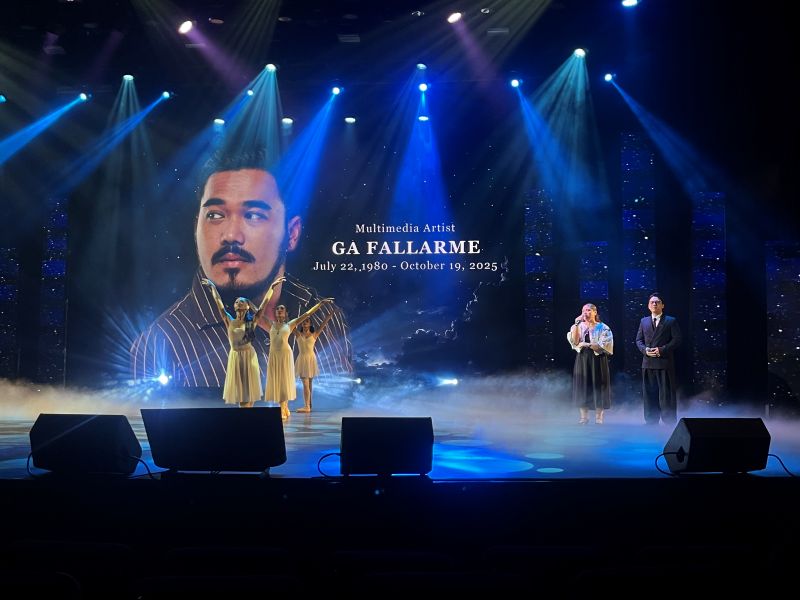
In memoriam tribute to the life and career of projection designer GA Fallarme (Photo by Vincen Gregory Yu)


