
This is published from Leon Gallery’s The Magnificent September Auction 2026 catalogue.
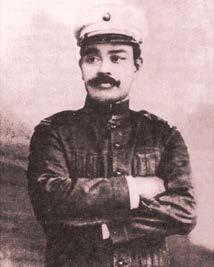
Gen. Antonio Luna
The assassination of Gen. Antonio Luna has been the subject of speculation and controversy since that fateful day of his death on June 5th 1899.
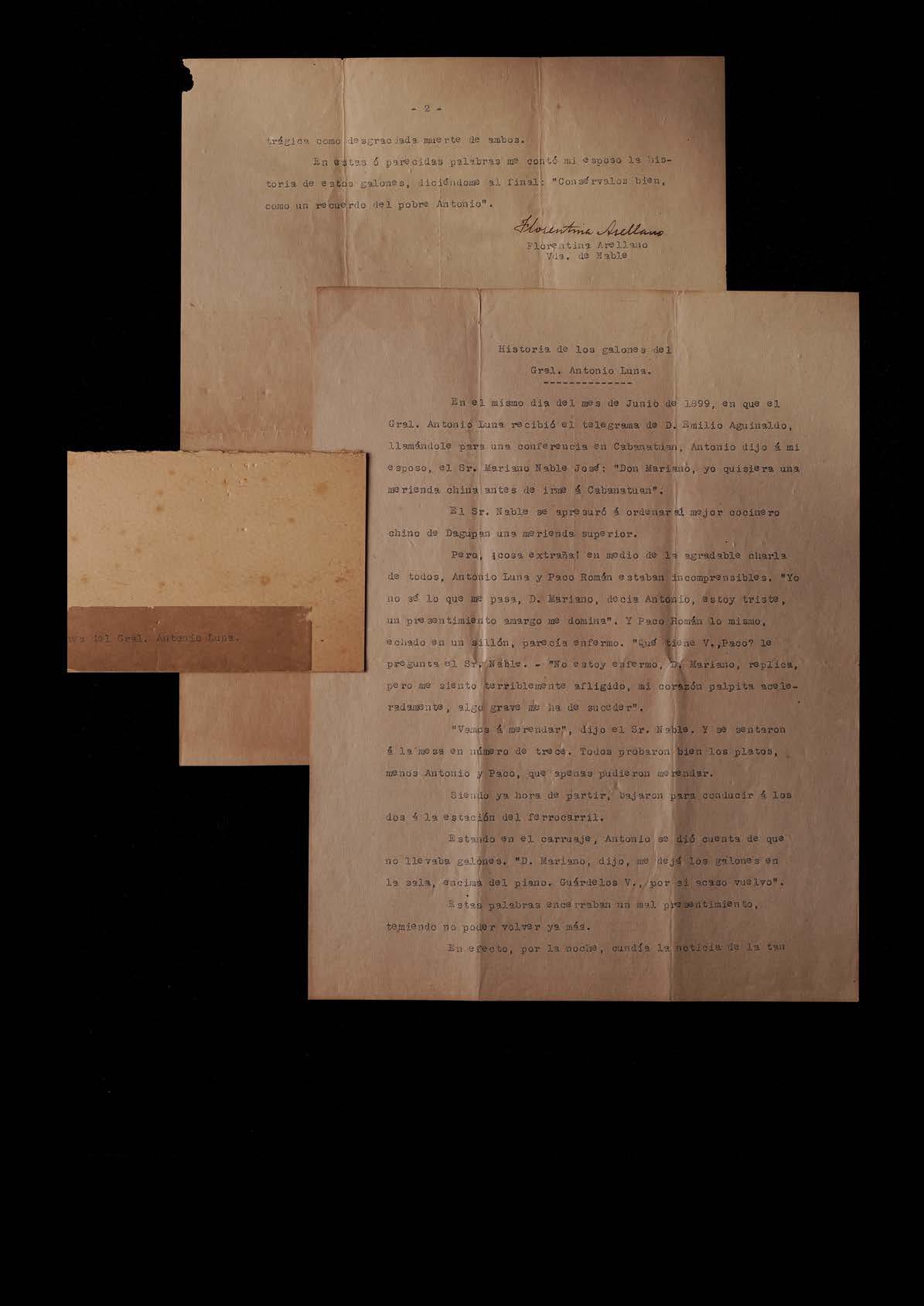
Finally revealed after 127 years, an account of the morning before he perished has come to light: the written testimony of Doña Florentina Arellano, a contributor to Luna’s revolutionary paper, La Independencia, with whom Luna spent some of his last hours.
Doña Florentina was married to a prominent member of the Dagupan principalia (or landed elite), Don Mariano Nable. Both were close personal friends of the general whose headquarters was in the nearby town of Bayambang, where Luna oversaw the Republic’s military actions as its acting Secretary of War. In the next town of Bautista, in fact, was where La Independencia was produced and printed. A railroad line still ran, in fact, from Dagupan to both towns and thence to Cabanatuan, and almost certainly Luna had access to a private railroad car.
Arellano’s account begins, “On the very same day in the month of June 1899, in which Gen. Antonio Luna received the telegram from D. Emilio Aguinaldo, calling him for a conference in Cabanatuan, Antonio said to my husband, Mr. Mariano Nable José: “Don Mariano, I would like a merienda China (Chinese merienda) before going to Cabanatuan.”
Countdown to Cabanatuan
Eye-Witness Account of Luna’s Last Morning
-

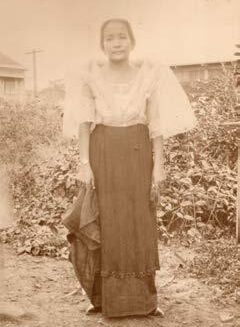
- Doña Florentina Arellano
-
- Don Mariano Nable
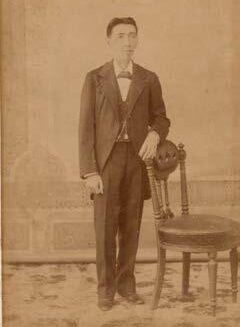
Don Mariano then made arrangements for one “prepared by the finest Chinese chef in Dagupan.” But when Luna arrived for the feast the next day, the general’s lighthearted mood had turned somber.
Doña Florentina, a talented and practiced writer, described the scene in detail. The table was set for 13 guests, the same ominous number as the Last Supper. In the midst of the festivities, both the general and his right-hand man, Colonel Francisco Roman, suffered inexplicable anxieties. “Estoy triste, un presentimiento amargo me domina, (I am saddened and a bitter premonition has come over me),” Luna declared. Roman sat slumped in an armchair and said he “felt much afflicted; his heart beating so fast because he felt an overpowering dread.” Both men were unable to eat more than a few morsels of the splendid spread their hosts had prepared.
For decades, historians believed that the telegram had summoned Luna to Cabanatuan. Even Doña Florentina, in her account, said that Luna had been “called for a conference” (llamándole para una conferencia.) Luna’s biographer Vivencio R. Jose would speculate that he had been promised various honors, from a permanent appointment as Secretary of War to the chance to form his own cabinet, and even possibly Aguinaldo’s agreement to his hard line against the Americans — and was, therefore, in a rush to go to Cabanatuan.
As for the telegram itself, some experts believed that the fateful telegram had disappeared, dissolved by the blood of his attack, and was confiscated by Buencamino when his assailants had rifled through his pockets.
The fatal telegram (or one of them, anyway) sent to General Luna would surface at a Leon Gallery auction in 2018, and is very likely the same one Arellano referred to in her account, as it was sent to Dagupan from Cabanatuan. (Scholar Jim Richardson, examining the telegraph records of that day, noted that General Aguinaldo had sent a flurry of identical telegrams to different locations to ensure that Luna would receive the message. That, he noted, would probably have only infuriated the General further.)
Partly in code, deciphered by the noted historian Ambeth Ocampo, and partly in Spanish, the telegram reads as follows:
No. 224
Sent to Dagupan from Cabanatuan
4th of June, 1899, 8.25 am
Received in Bautista at 9.40 am, 4th of June, 1899
President of the Republic to the Secretary of War, Dagupan
“Folabo (Felipe) puoncimane (Buencamino) iun (aun)
thiundotonade (detenido) sin ordenar fegmicaen (formación)
ciusi (causa) Esperando contestación a mi telegrama
anterior en que le pedía piso (base) incupsicaen (acusación).
Suplico urgencia.”
“Felipe Buencamino is still detained, without formal charges being filed. It continued in Spanish, “Await a response to my previous telegram in which I asked you for the basis of the accusation. I urge your immediate attention.” Ocampo added, “The decoded words in parentheses match Luna’s scrawl at the bottom of the message perfectly except for one letter crossed out in ‘acusacion.’” (The telegram was auctioned as Lot 122, The Leon Gallery Kingly Treasures Auction 2018.)
Felipe Buencamino, both Secretary of Foreign Affairs and of the Interior, was Luna’s arch-foe in the cabinet. He had proposed peace talks with the Americans at one meeting, for which Luna had slapped him and called his son, who had fallen in battle, as cowardly as the father. Buencamino would later complain angrily that Luna never stopped persecuting his family, hounding his brother and daughters into hiding, for fear of their lives.
Luna clung fiercely to the idea of independence at any cost and denounced all those who wished to give up the fight as turncoats. Just weeks before, Luna had ordered the arrests of everyone who sought to come to terms with the American commission that had been sent to the Philippines to negotiate the Republic’s surrender. Those orders included Felipe Buencamino and Pedro Paterno.
None of the telegrams actually summoned Luna to Cabanatuan, but they were designed to provoke his anger and lure him to Aguinaldo’s turf. Whoever sent the telegram knew exactly how to set the trap to bring down the General. Days before, troops and even artillery had been deployed around Cabanatuan, and Aguinaldo had given instructions that if Luna made any trouble, he could be dealt with severely and with prejudice.
Very likely the “fog of war”, induced by fighting the war against the Americans on dozens of fronts, made Luna fail to consider that he was in mortal danger. Instead, Luna headed straight to Cabanatuan, not to claim any personal honors (as Vivencio Jose had it), but to press his non-negotiable case to fight on for independence personally to President Emilio Aguinaldo — and to ensure that Felipe Buencamino would remain behind bars as a traitor to the Republic. Aguinaldo had asked him to produce evidence of Buencamino’s guilt, and he would deliver it.
He would have one last chilling premonition when saying his farewell to Don Mariano to keep his epaulets safe, ‘if he should ever return’
Luna was now sufficiently preoccupied as to forget his epaulets and cockade (the ceremonial emblem for his hat) as he left the Arellano-Nable house to go to the railway station. In his rush, the adornments had been left on top of the piano in the main sala, and Luna only realized it when he was some distance away in the carriage with Don Mariano. He would have one last chilling premonition when saying his farewell to Don Mariano to keep his epaulets safe, “if he should ever return.”
When Luna arrived in Cabanatuan that afternoon of June 5th, he was without most of his entourage and armed retinue. He entered the convent house alone, only to find Felipe Buencamino not behind bars but prowling the premises, surrounded by the officers and men he had disarmed for insubordination. Baffled and enraged, Luna launched into a tirade. He may not have realized what was happening until he was struck with the first blow. So inconceivable was the idea that he would be attacked in such a vicious and treacherous manner.
What followed was one of the most terrible scenes in Philippine history, committed in broad daylight in the plaza of Cabanatuan, where Luna had continued to repel his assailants, fighting till his last breath. Luna and his two trusted officers were finally cut down; and Luna in particular was so butchered that his uniform had been cut to shreds by bolos and bullets. Col. Roman was shot repeatedly at close range; the bullet holes in his uniform were still smoking when the attack ended.
The epaulets (and the cockade) would be the only thing to survive for more than a century, having been left unwittingly in the safekeeping of Luna’s loyal friends, passed down secretly from one generation to the next. For Doña Florentina, her blood had run cold when she heard tell of Luna’s sad parting words, made true that evening when news arrived of the General’s horrific death.
These last-known personal possessions of Antonio Luna symbolize his glorious vision of a free and independent Philippines and the mission of a general dedicated to see it through, even at the cost of his life. They are one of the few remaining remembrances of the once-glorious First Philippine Republic.
A Brotherhood in Gold and Silk
Juan Luna’s Design, Antonio’s Defiance
And Their Last Struggle for the Nation
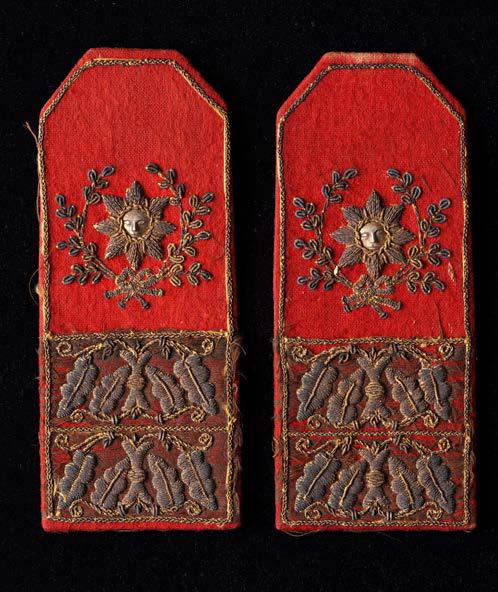
The Gen. Antonio Luna Epaulets
designed by Juan Luna
c. 1899
epaulets: fine silk embroidered with gilt thread and
metal appliqués, on board
5” x 2” (13 cm x 5 cm) (each)
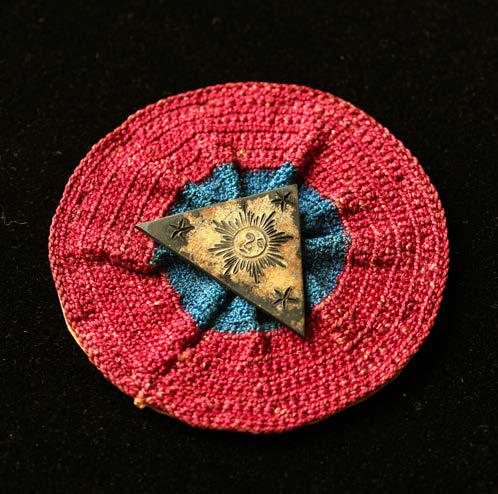
With The Gen. Antonio Luna Cockade
c. 1899
Silk crochet with triangular metal emblem of the First
Philippine Republic, on board
diameter: 2 1/4 (6 cm)
Accompanied by the never-before-seen personal
typewritten account of the last morning of Gen.
Antonio Luna, signed by his friend and fellow journalist,
Florentina Arellano de Nable.
Two sheets of paper
11” x 8 1/4” (28 cm x 21 cm)
P 1,000,000
PROVENANCE
Doña Florentina Arellano, married to Don Mariano Nable, received from
Gen. Luna in Dagupan on the day of his death, June 5, 1899.
LITERATURE
Photograph of Luna’s designs featured in Felice Prudente Sta. Maria,
Visions of the Possible: Legacies of Philippine Freedom, 1998 (Studio 5
Publishing, Makati), 246-247.
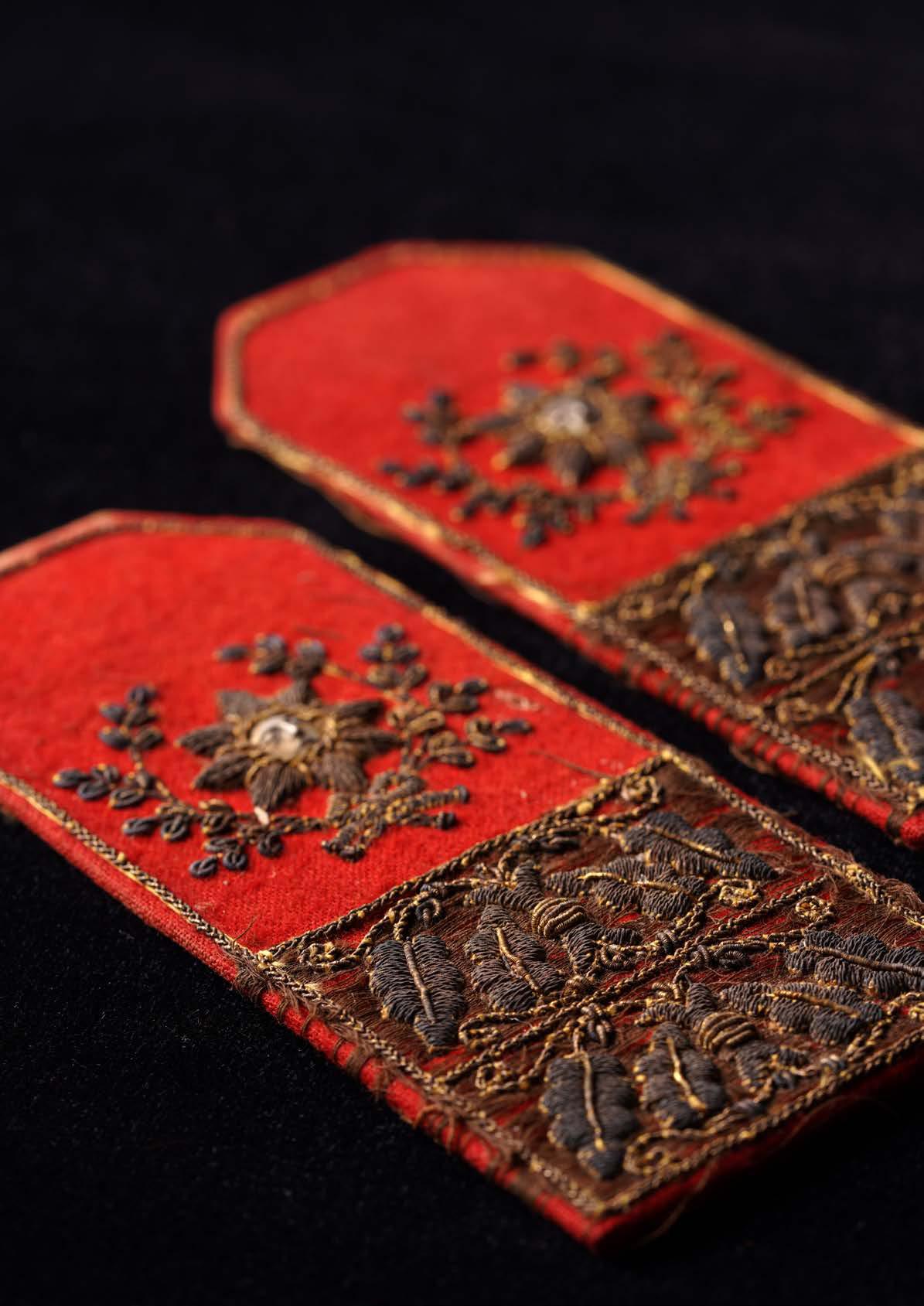
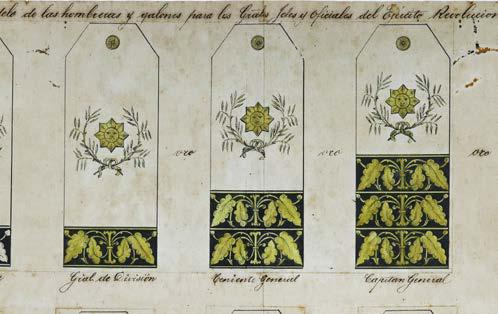
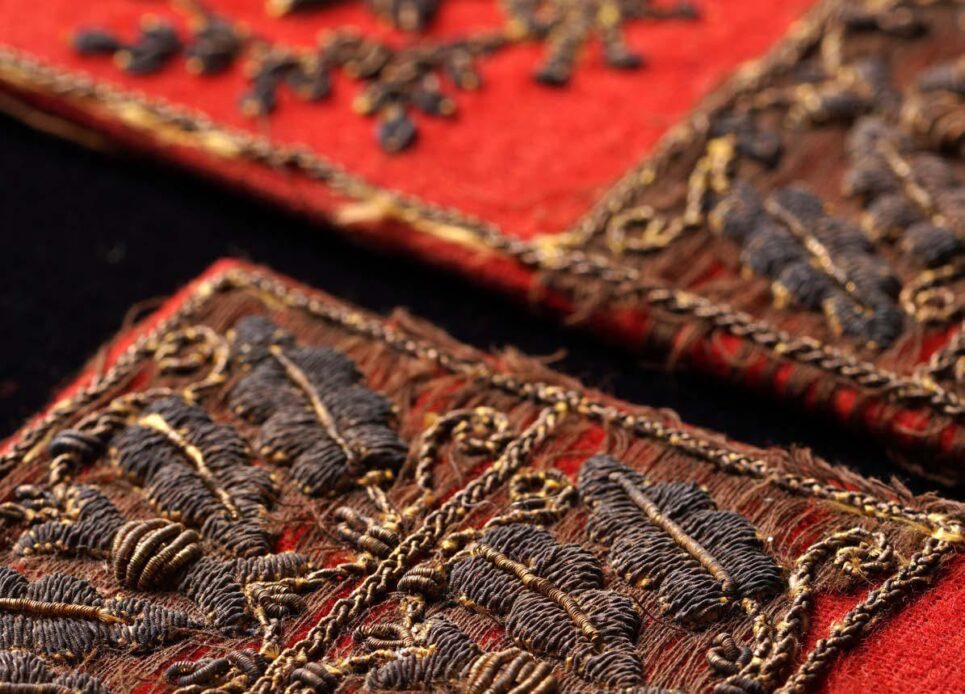
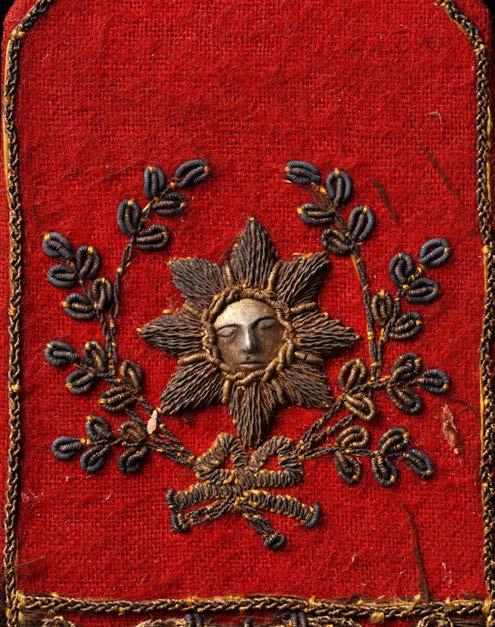
The magnificent pair of epaulets was faithfully reproduced from designs made by General Antonio Luna’s brother, the famous artist, Juan Luna.
Luna had been promoted to Lieutenant General just months before in 1899, and the epaulets correspond exactly to his older brother’s designs for that rank. (The drawing was titled “Modelo de los hombreras y galones para las Grales, Jefes, y Oficiales del Ejercito Revolucionario or Design of the epaulets and stripes for the Generals, Chiefs, and Officers of the Revolutionary Army”, and was from the Grace Luna de San Pedro estate, having passed down to Juan Luna’s son, Andres. It was auctioned as Lot 92 of the Leon Gallery Magnificent September Auction 2018.)
The epaulets feature gold-thread embroidery on a scarlet field of fabric, edged further with gilt threads twisted together. At the center of the shoulder boards are finely cast metal suns (possibly of gold or silver) with a human face at each center. The mythological sun is at the heart of the First Republic’s iconography, as it was for the Katipunan, symbolizing the vision of freedom and equality as it shone down on the Filipino people. Crowning these suns are wreaths of bamboo leaves tied with ribbons. It is a patriotic nod to the resilient Filipino tree but mimicking the traditional laurel leaves that have symbolized victory since the time of Caesar.
Two rows of oak leaves denote the rank of Lieutenant General, or second in command to the Captain-General (which would be Aguinaldo). These are equally elegantly wrought with raised embroidery. Oak leaves traditionally symbolize strength, endurance, and high rank.
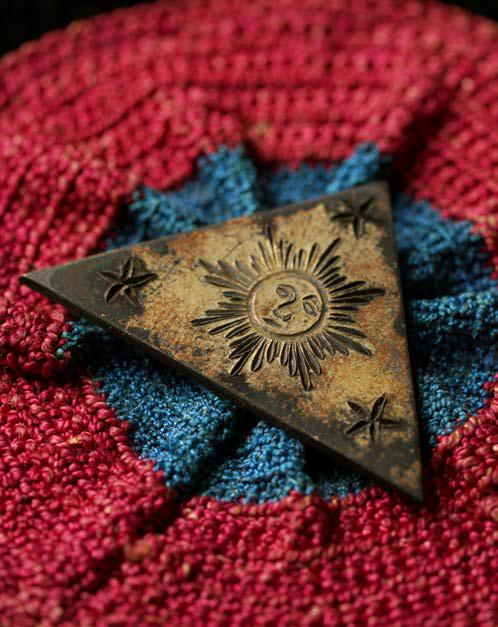
The epaulets are accompanied by a cockade, or hat emblem, of delicately crocheted ribbons in brilliant red with an azure center, sewn together to make a circle. At its center is a triangular metal plate, possibly silver. It features a sun with a human face surrounded by eight rays, and the three stars at each corner once again echo the symbolism of the Katipunan and the flag of the First Philippine Republic.


