
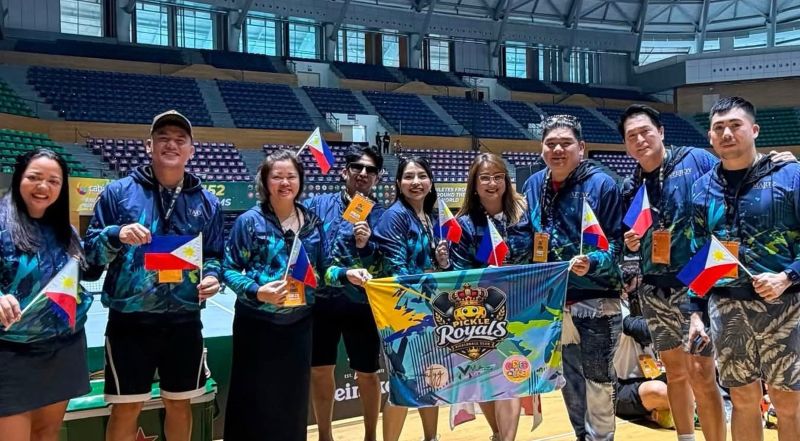
We showed up for the Pickleball World Cup. It was a reason for us to travel, to experience Da Nang, and to play at an international level. What I didn’t expect was for the tournament to become something much bigger than pickleball.
The Heineken Pickleball World Cup 2026, held August 30 to September 6, was the first Pickleball World Cup to be held in Asia, bringing nearly 5,000 athletes from 81 countries and territories to Da Nang. For a sport that has grown so quickly around the world, having that many players congregate in one destination was something else. Everywhere you went, there were athletes carrying paddles, wearing their country’s colors, looking for their next venue or meeting up with teammates. Da Nang, for those few days, felt like the center of the pickleball world.
At first, I felt the nerves. “What am I doing here?” was on my mind during our on-site check-in at the Tien Son Sports Arena. The venue itself made everything feel real. This wasn’t just another local tournament or weekend open play. We were surrounded by athletes from different countries, different levels and different backgrounds, all there for the same reason. Seeing the flags and athletes gathered in one place made me realize just how big the event really was.
I felt like I wasn’t prepared. I didn’t even do any training other than our weekly open plays and a pre-World Cup local tournament, where we reached the quarter-finals and I was already happy with that. I said, if I only score five points, I will be happy. My mixed-doubles partner and I ended up scoring 26 points in our last game, played to 21 points with rally scoring, where a point is awarded on every rally and you have to win by two.
We lost to Macau, who went on to bag the silver medal. We also lost to Mongolia, and I still can’t believe we actually got to play against them. One of their players had been in the Professional Pickleball Association (PPA) Tour Asia 2025 finals in Hangzhou Open with his partner from Hong Kong, who even had her own personal coach with her. Never in my dreams would I have imagined playing against players at that level.
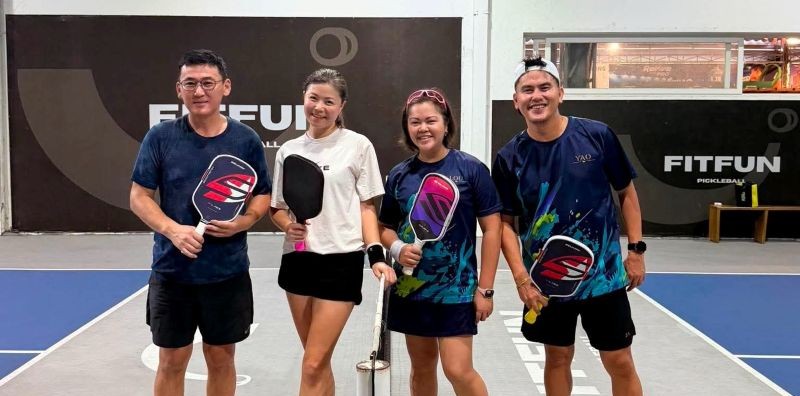
The author with mixed-doubles partner Yao Lim and Mongolia’s Gantulga Zagdsuren and Hong Kong’s Choi Wai Yi Cat
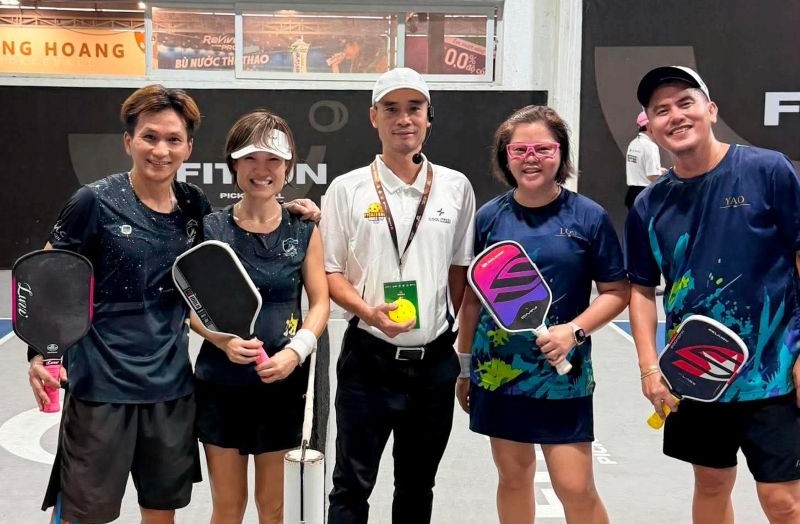
The author with mixed-doubles partner Yao Lim and Macau’s Si Wek Tang and Weng Yu Tai
And then we beat France on a 26–24 rally score. It was the toughest match I’ve ever had to face, and although I was incredibly proud of that game, it wasn’t the best win for me. The best part of the World Cup happened outside the scoreboard.
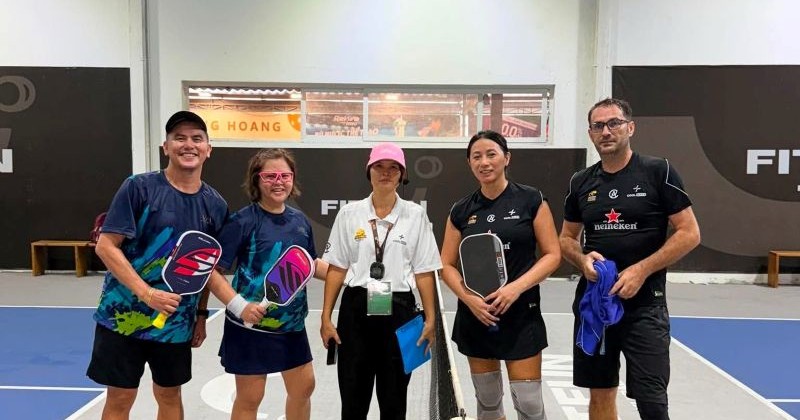
The author with mixed-doubles partner Yao Lim and Team France’s Veronique Jayet
How did we prepare for the Pickleball World Cup? We didn’t just learn our partners’ skills and movements and how they were on the court, but how we were off the court. We cheered each other on. We relied on each other. We learned each other’s personalities, strengths, and weaknesses, and understood how we could be there for one another when the pressure of the games came.
It was about the preparation that nobody sees, learning your teammates beyond the court. We spent two days exploring Da Nang together instead of doing drills. We ate together, walked around the city, talked, and laughed. We got to know each other outside of pickleball, and in retrospect, I think that was just as important as any training we could have done.
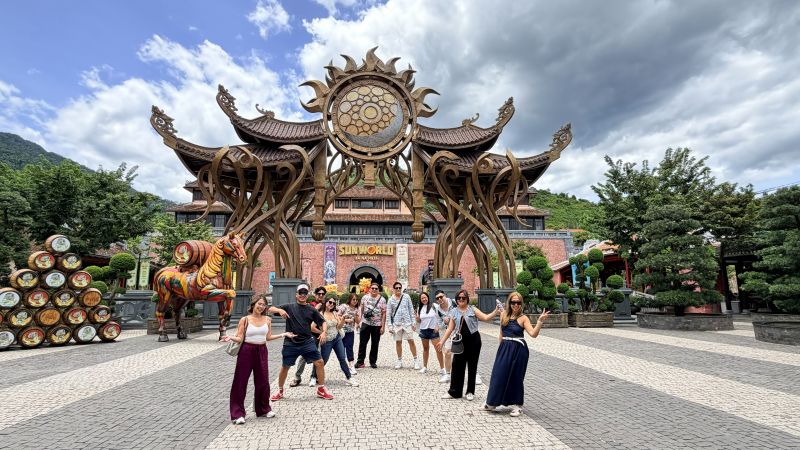
The Pickle Royals in Ba Na Hills, Da Nang
We prepared for the World Cup by learning how to play together and how to be there for each other. Pickleball can look like an individual sport because once you step onto the court, it’s you and your partner against another team. But representing a country at a World Cup makes you realize that you are never really playing alone.
Our games were separated among three venues, some across from each other and others side by side. After each game, instead of doing post-game analysis, we went to our other teammates’ courts to see how they were doing and to give encouragement. We wanted to know how everyone was playing, whether they had won or lost, and whether they needed someone there. Sometimes it was simply about being present.
The World Cup gave everyone a reason to pack a bag and travel together. The experience became so much more than pickleball. The shared meals, conversations, nerves, cheering from the sidelines, and even the exhaustion became part of the competitive experience. We were experiencing something together, and that shared experience brought us closer.
This is what it really takes to play as a team. It can look like an individual sport, but we built teams not just by putting ourselves on the roster, but by making every player feel they were not alone. We learned that being a teammate doesn’t stop when your own game ends. Sometimes being a teammate means walking to another court to watch someone else play, cheering for them when you’re already tired, or simply asking how their game went.
What was I doing here in the amateurs, representing our country? Honestly, I simply didn’t want to be an embarrassment. I just wanted to play at the international level and be done with it, for the experience. I never imagined that the experience of having other Filipinos cheer you on would make me feel so proud. It was giving me Alex Eala feels.
You hear about athletes representing the country all the time, but being there yourself gives the words a different meaning. Hearing fellow Filipinos cheer from the sidelines, seeing the Philippine flag beside your name, and knowing that other Filipinos were watching and rooting for you made the experience feel much bigger than my own game. I went there just wanting to participate, but suddenly I felt like I was representing something.
And it wasn’t just about fellow kababayan. We forged friendships with other nationalities, too. We would run into people we had played against or met at the venues and they would greet us warmly after the games. There was something special about seeing familiar faces from different countries throughout the tournament. We may have been competing against each other, but there was also this mutual understanding of what we were all experiencing.
Everyone was nervous and just wanted to compete and win to represent their country well. But everyone was also there because they loved the sport, and that created an instant connection. The World Cup brought together people who probably would never have crossed paths otherwise, and for a few days, we shared the same courts, restaurants, hotels, streets, and conversations.
After the amateur games were done, we looked for our fellow Pinoys who played in the pros division. We watched Sarah Jane Lim-Narvasa and Leander Lazaro, as well as Johnny Arcilla and Ruben Gonzales, with pride. Seeing fellow Filipino athletes competing in a World Cup setting made me feel so proud and gave me a sense of nationalistic pride I’ve never felt before.
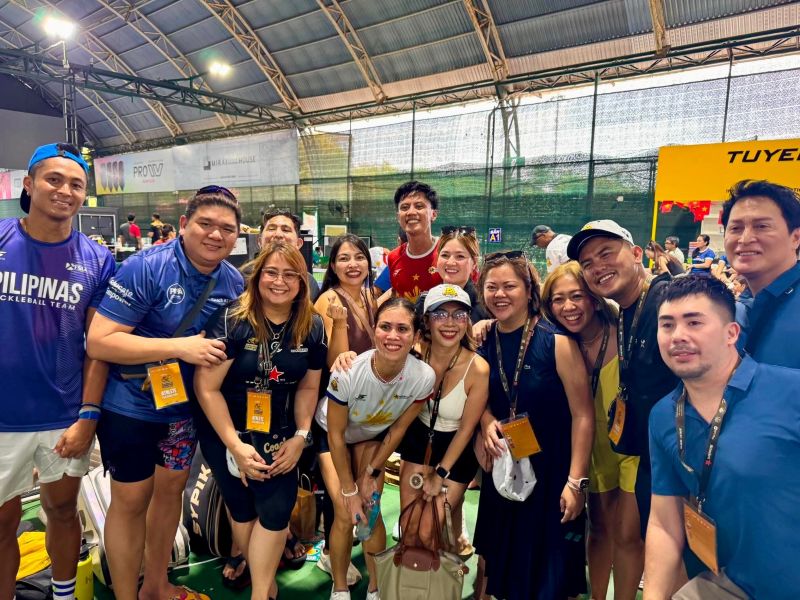
The Pickle Royals with Team Pilipinas’ Ruben Gonzales, Sarah Jane Lim-Narvasa and Leander Lazaro
Leander Lazaro and Sarah Jane Lim-Narvasa were among the Philippines’ leading players in the tournament, while Johnny Arcilla and Ruben Gonzales brought years of experience from professional tennis into pickleball. Arcilla, in particular, was a familiar name from Philippine tennis, having built an impressive career before making the transition into professional pickleball. Watching athletes with that kind of background compete for the Philippines in a World Cup made me appreciate how far the sport has come and how much potential there is for Filipino players.
It was also inspiring to see the professional players after spending our own days competing as amateurs. We had just finished our games, experienced the nerves and pressure ourselves, and then we were watching Filipino athletes take on some of the best players in the world. There was a sense that we were all part of the same Philippine pickleball community, regardless of whether we were playing in the amateur or professional division.
Everyone arrived wanting to compete and win, and I was no different. But by the end, the definition of winning had changed. The tournament was proof of what happens when people show up for one another. We became family and realized that by that alone, we had already won.
The matches and the wins matter, of course. I will always remember beating France, especially because of how difficult that match was and because I had gone into the tournament thinking five points would already make me happy. But when I look back at the World Cup, I know that the score will not be the only thing I remember.
I will remember the people who were there.
I will remember watching our teammates play after finishing our own games. I will remember the cheering from the sidelines, the shared meals, the conversations, the nerves before a match and the relief afterward. I will remember walking around Da Nang and seeing players from so many different countries gathered in one place. I will remember the Filipinos who cheered for us and the friendships we made with people from other nationalities.
Most of all, I will remember the feeling of being part of something bigger than myself.
We didn’t show up to play, we showed up for each other. The World Cup was the destination, but the real story was the people who made the journey together. The best win wasn’t what happened on the scoreboard, it was finding a family along the way. We forged a bond that can’t be broken, and playing pickleball with The Pickle Royals family is the best win of all.
I went to Da Nang wanting to play at the international level and experience what it was like to compete in a World Cup. I came home with friendships, memories, a deeper appreciation for the sport and, most importantly, a group of people I now consider family.
Perhaps that is what the World Cup really gave us. It gave everyone a reason to travel together, to compete together and to experience something that none of us would have experienced in quite the same way on our own.
And somewhere along the way, we realized that winning wasn’t just about the points we put on the scoreboard. It was about the people standing beside us, the people cheering from the sidelines and the people who showed up when we needed them.
We showed up for the Pickleball World Cup. But really, we showed up for each other. And by the end, we realized we had already won.
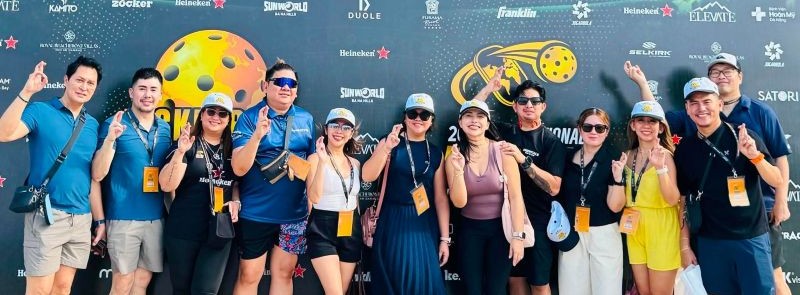
The Pickle Royals at the Heineken Pickleball World Cup L-R: Weeboy Pineda, Martin Santos, Yna Melitante, George Melitante, Kath Reyes, the author, Kym Dumapias, Myk Dumapias, Ana Kim, Sarah Besitan, Yao Lim, John Kim


