
Two weeks ago, I was supposed to review the opening matinee of Philippine Educational Theater Association’s (PETA) Control + Shift Changing Narratives Festival. By some farcical twist of fate, I ended up onstage during the performance.
Before I go any further, I’d like to put on record that I love a good audience participation bit. My fellow theater reviewers can attest to the boisterous fun I’d have—much to their long-suffering amusement—during the interactive segments of Repertory Philippines’ productions for children.
In Control + Shift, however, I’d planned to keep a low profile, discovering quite early on that I was the only media in attendance, amid a sea of high school and college kids, teachers, and company affiliates. Obviously, that plan didn’t last long.
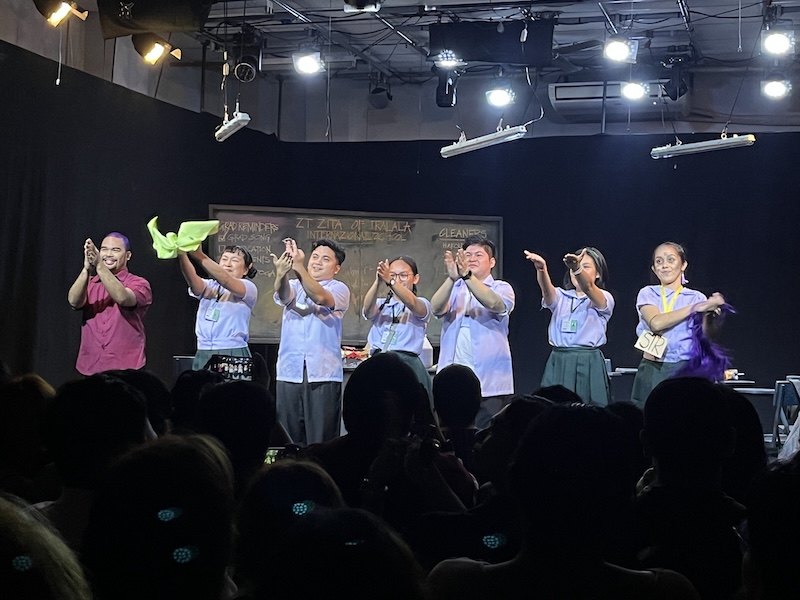
My unraveling, as it were, began during the open forum that followed the afternoon’s first play, Jhudiel Clare Sosa’s Cleaners.
Cleaners was about a group of students who, while cleaning their classroom after hours, uncover some pretty diabolical secrets which could be linked to their dictatorial teacher. It was evidently new work, its many rough edges untrimmed—making the festival the perfect venue for public debut. While the production directed by Julio Garcia—a Gawad Buhay-nominated designer for Walang Aray—took some time to hit its stride, it also managed to serve outrageously good physical comedy.
In the ensuing open forum, it was clear the play had fulfilled its job as pedagogical theater, in keeping with PETA’s singular, time-honored mission. The audience engaged eagerly with the play’s parallels to the Duterte years, from the ethos of “cleanliness”—whatever it meant—that the fictional school forced upon the characters, to the gruesome, buffoonish unfolding of events involving a skeleton of sorts in the broom closet.
But I can pinpoint exactly when my brows first went up: Reacting to the play’s ending (spoiler alert), in which the students overpowered their teacher, possibly killing him, someone from the audience—not a student—said that PETA, or playwrights in general, should be more careful with depicting revolutionary action that ends in what that person termed a “bad cause”—in other words, that killing the evil teacher (or whoever this character symbolized) was—and will never be—okay, insofar as it’s meant to be a teaching moment.
In that instant, I couldn’t help flashing back to the most iconic works of Raffy Lerma, Ezra Acayan, and the other photojournalists
In that instant, I couldn’t help flashing back to the most iconic works of Raffy Lerma, Ezra Acayan, and the other photojournalists who comprised The Nightcrawlers, who immortalized day after dreadful day some of the most abhorrent and horrific images of Duterte’s genocidal anti-drug campaign. Aren’t we lucky, I thought, to have the luxury of chest-beating for “moral values” from the sheltered, privileged comforts of this air-conditioned theater—while 30,000 or so mostly poor Filipinos were murdered during those six horrible years? Human rights workers like Reina May Nasino, whose infant died while she was wrongly imprisoned by Duterte, and the activists who were slain during Bloody Sunday of 2021 might have something to say about good and bad causes.
I swiftly shrugged the moment off, chalking my reaction up to the fact that I was not the target audience of the open forum.
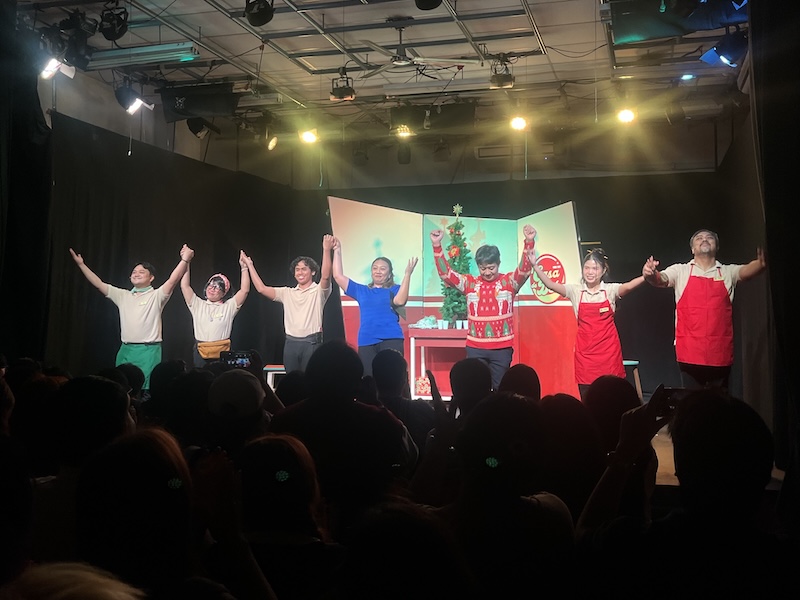
Cast of ‘Monit-oh! Monit-ah!’ at curtain call (Photo by Vincen Gregory Yu)
Before long, it was time for the second play: Herlyn Alegre’s Monit-oh! Monit-ah!, returning from the previous year’s festival. Alegre wrote the play as forum theater, an interactive and participatory format wherein the audience has a say on how the play progresses, including by deciding what a character should do in crucial junctures of the story.
On the whole, the production directed by Norbs Portales was loads of fun. Monit-oh! Monit-ah! was preoccupied primarily with the inane behind-the-scenes of a food business. Jaylord, a probationary newbie, finds himself the witness to the petty little thefts that his co-workers carry out at the workplace, as well as a conflicted participant to the pálakásan culture that defines the existing relationships among his peers.
Every now and then, when a character (mainly Jaylord) encountered a moral dilemma, the moderator Zoe Damag would interrupt the proceedings and not only ask the audience what that character should do—usually a question answerable by plain yes or no—but also launch a mini-open forum tackling that dilemma. Should Jaylord accept a bribe from his manager? Should he snitch on a co-worker?
Here the audience was even more engaged. In a moment of peak comedy, someone suggested that the nosy, holier-than-thou character played by the wonderful Pia Viola should spy on a possibly consequential conversation between two other characters; Viola gamely hammed it up, not-so-innocuously stalking the peripheries of the conversation like a cross between Edna Mode from The Incredibles and Velma from Scooby-Doo.
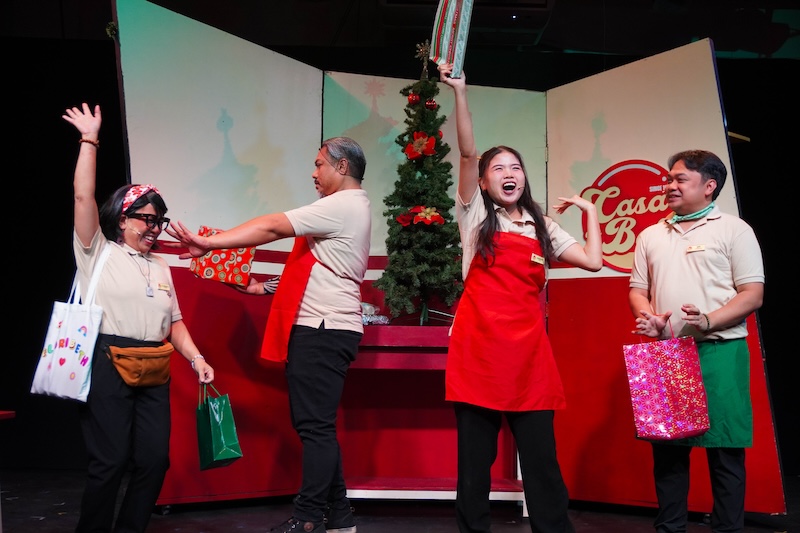
Pia Viola (left), Ash Nicanor (third from left), and co-actors in ‘Monit-oh! Monit-ah!’ (Photo courtesy of PETA)
Yet, I also quickly found the discussions borderline frustrating. And because of these protracted discussions, the play itself started to feel long.
In particular, I thought the debates lacked a general awareness of the concept of structural violence. Everyone was rather hyper-fixated on judging the actions of the individual for what they were—i.e., stealing from the workplace is always bad, accepting bribes is always bad, and so on—with no notion of the proverbial larger picture. There was little in the way of genuinely interrogating the contexts behind a character’s morally dubious actions, or even the very ideas of good and bad—especially since the play seemed intent on driving home a specific brand of morality. One teacher even said that we should always do the “right” thing: “I may be far from reality,” she said, “pero ‘yan dapat ang tama.”
She was not wrong; I thought her comment had a point—but was also pretty myopic in its lofty idealism.
In sociology and anthropology, structural violence is a central concept referring to the harms caused by the social, structural, and institutional conditions shaping people’s lives—a form of indirect and invisible violence inflicted by laws, policies, and prevailing norms. And because it is invisible, it is often overlooked, ignored, unlearned.
During the play, the discussion had apparently fallen into the trap of a mindset in our neoliberal age: Blame was always pinned on the individual, the concept of responsibility limited to the actions of exactly one entity. So, the minimum wage earner Jaylord, with an ailing parent and hardly any savings to speak of, had to be condemned for accepting a bribe, or turning a blind eye to a theft in the workplace due to pakikisáma—while the system of stagnant wages, flawed labor laws, and relentless corporatism in society was largely ignored. Judgment was passed only on the small man, and never the big, unseen forces surrounding him and tethering him to his woes.
Was it too much to have expected the discussion to dive into the sociological? Perhaps, given that this was a young crowd. However, especially since there were teachers in attendance, the play could have also been the perfect teaching moment, an opportunity to broaden the minds of the students by inviting them to imagine a world beyond the individual: pedagogical theater at its best. Outside, a fuel crisis was in full swing, a neocolonial war in West Asia showed no signs of stopping, and an impending impeachment trial loomed large over Philippine politics. And we’re supposed to hyperfixate on stopping Jaylord from doing something “wrong”?
Was it too much to have expected the discussion to dive into the sociological? Since there were teachers in attendance, the play could have also been the perfect teaching moment
Tired of the quasi-sermonizing tone of the talk, I decided to take matters into my own hands, aiming to deliberately give an out-of-left-field answer to the next question and hopefully inject an audience-provided, moral gray area to set up the succeeding scene.
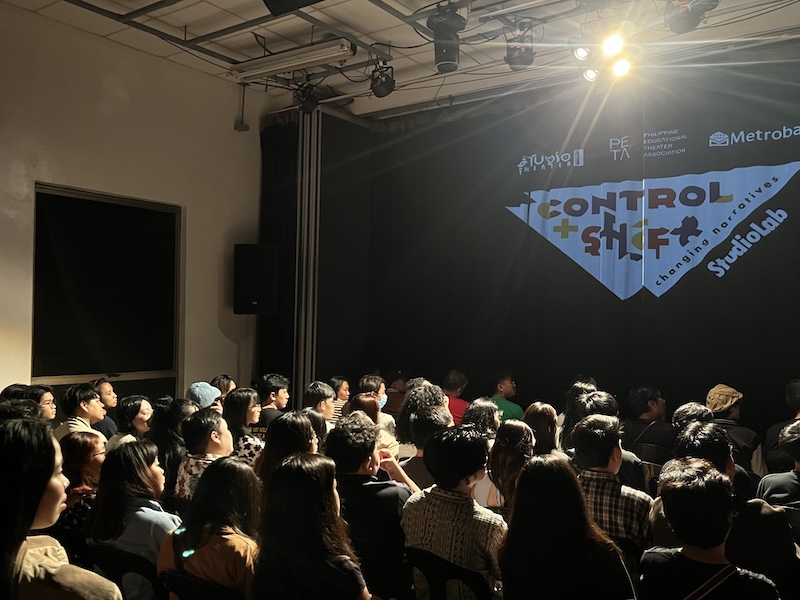
Packed house for ‘Control + Shift’ at the PETA Theater Center (Photo by Vincen Gregory Yu)
In the play, everyone’s “bad” deeds were now coming to light—and Viola’s nosy character was threatening to involve the company’s big boss and the Department of Labor and Employment. What should happen next, Damag asked as moderator?
“We find out,” I said, microphone in hand, “that the boss is actually the lover of the manager, and that he already knows about these petty misdeeds in his business.”
Unfortunately, Damag said, there weren’t enough actors in the production to play this new character of the big boss-slash-lover—which meant he who furnished this new character must come forward and play it himself. Of all the questions I could have answered, I somehow picked the one that entailed the cameo? Not for nothing did Norma Desmond tell Mr. DeMille she was ready for her close-up all those years ago.
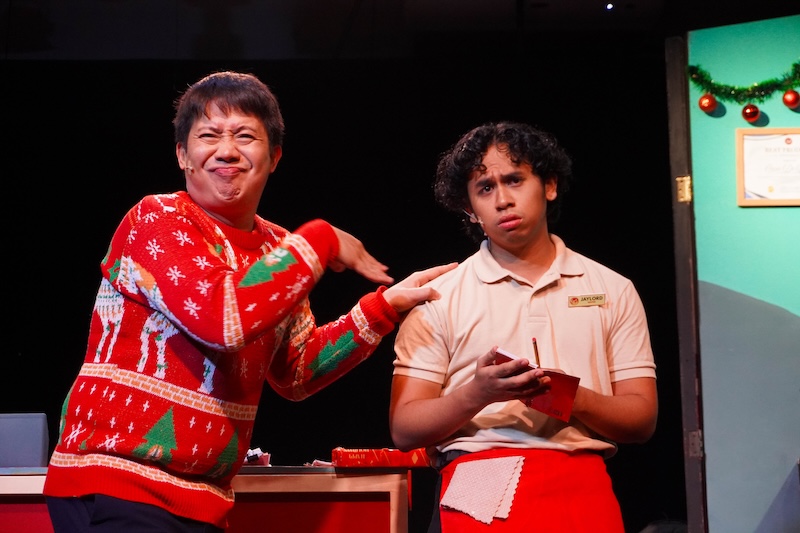
Gino Ramirez as manager and Moi Gealogo as Jaylord in ‘Monit-oh! Monit-ah!’ (Photo courtesy of PETA)
Onstage, I found myself in a kind of out-of-body experience, realizing that I was suddenly appearing in the play I was supposed to be reviewing—must I now review myself as well? It was also distracting—in the best possible way—to watch the actors commit to the bit. One of them was Ash Nicanor, a riot as a TikToker housemaid in last year’s Let’s Do Lunch, who was now begging me to let her keep her fictional job. Viola’s nosy character was refusing to stand down, and I had half a mind to declare her fired. At some point, Gino Ramirez, who played the manager, whispered to me: “Sabihin mo na lang, alam mo na ang lahat ng ‘yan.”
Only two months ago, I was watching Ramirez in KOLABorador Co.’s Lamay in Malaya, where he played a grief-stricken man who sought temporary solace in rough sex. Now he was my fictional lover—a fact I’d actually forgotten by then, interpreting his words as him guiding me, the volunteer actor, to wrap things up. Maybe I should just fire Viola’s character and be done with it, I thought.

Gino Ramirez (left) in a scene with the author in ‘Monit-oh! Monit-ah!’ (Photo courtesy of PETA)
By the time the curtain fell, it was nearly 5 pm. As Portales later said in a Facebook comment, if not for the scheduled evening show, we could have gone on all afternoon. More airtime for the boss, to the confusion of those poor kids and their teachers.
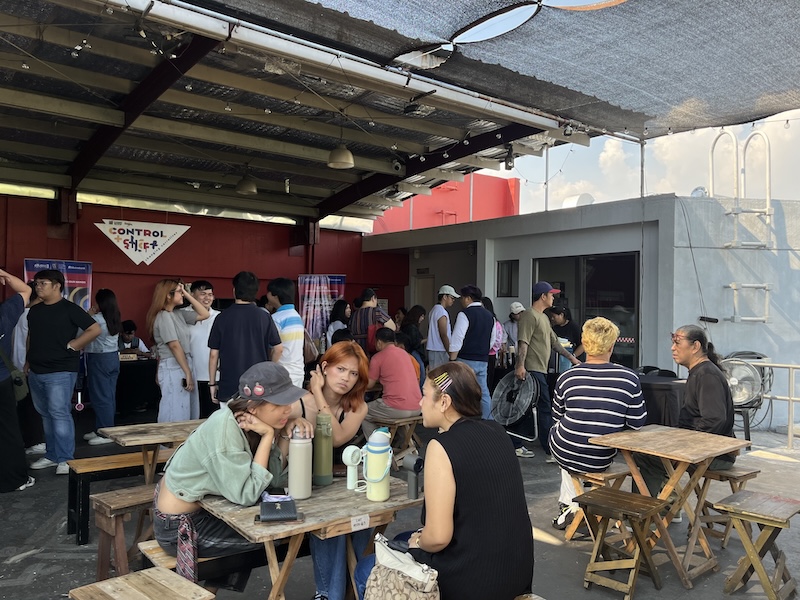
Audience members hanging out during intermission on the third floor balcony of the PETA Theater Center (Photo by Vincen Gregory Yu)


