
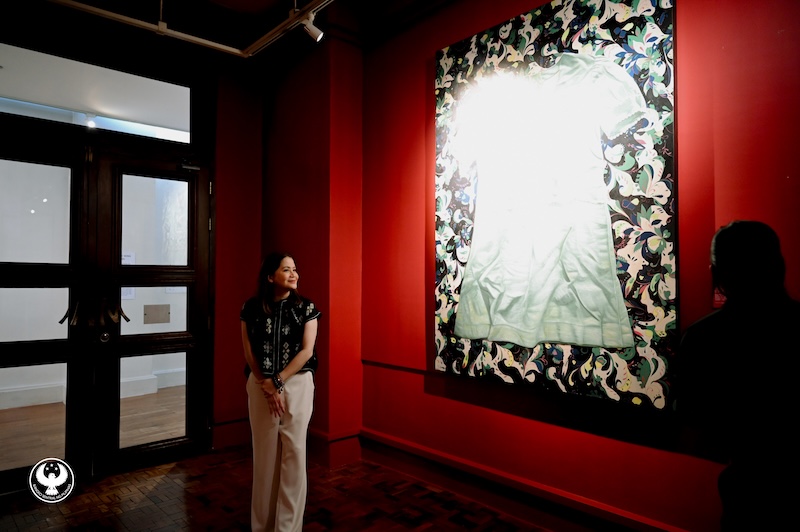
BSP Deputy Gov. Bernadette Romulo Puyat before Marina Cruz’s ‘Spring Beauty’
You have until Nov. 15, 2027 to view this rare exhibit of Philippine contemporary art from the famous Bangko Sentral (BSP) collection at the National Museum of Fine Arts on P. Burgos Ave., Manila.
The Galleries XVIII and XIX are featuring the specially curated selections from the extensive BSP collection. These two galleries are devoted to the BSP collection until 2027.
Opening its “vault” to the public, the Bangko Sentral ng Pilipinas (BSP) showcases a curated selection of its extensive contemporary art collection at the National Museum of Fine Arts. The exhibition, Kultura, Kapital, Kasalukuyan: Contemporary Art from the Bangko Sentral ng Pilipinas Collection, offers the public a chance to view significant works—35 in this current series— typically accessible only to BSP executives and staff.
The exhibit is from the vast and significant BSP collection, which now numbers around 4,000 pieces. It was started in the early 1980s by then-Governor Jaime C. Laya and has since been developed with the guidance of a team of qualified staffers. While BSP has loaned parts of its numismatic collection—including pre-colonial gold treasures from the Surigao Treasure finds—to the Ayala Museum and 100 artworks by Filipino masters such as Luna and Hidalgo and other classicists to the National Museum, it is uncommon for a significant body of its art holdings to be shown outside its premises.
Corporate collections often reflect the personal tastes of a company’s leadership, and the BSP’s collection began as a passion project of an enlightened governor. Today the bank is showing the value of this collection in showcasing and enriching the country’s culture as well as strengthening the BSP’s ties to the community, as a tool of public relations. This new direction is championed by the Regional Operations and Advocacy Sector, the BSP’s frontliner.
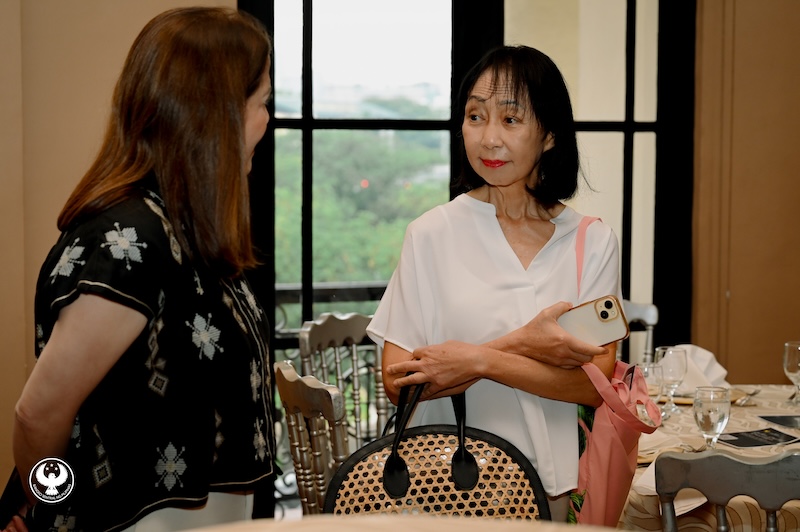
The author with Deputy Gov. Bernadette Romulo Puyat
Deputy Governor Bernadette Romulo Puyat, whose office also oversees the Museo Bangko Sentral ng Pilipinas, is leading this new initiative. She frames the exhibition as a philanthropic act that not only benefits the artists whose works are on display but also enriches the cultural life of the society.
The exhibition features 35 works from top Filipino artists spanning the 1980s to 2014, displayed in Galleries XVIII and XIX. These works capture the interplay between culture, art, and the social milieu in which they were created. The show is a clear sign of the BSP’s evolving role in cultural advocacy.
For years, the BSP has received requests from people asking to see its art collection. However, with the artworks displayed in offices and meeting rooms, public access has always been limited. While some small groups have been given tours of the meeting rooms, many pieces have remained in storage.
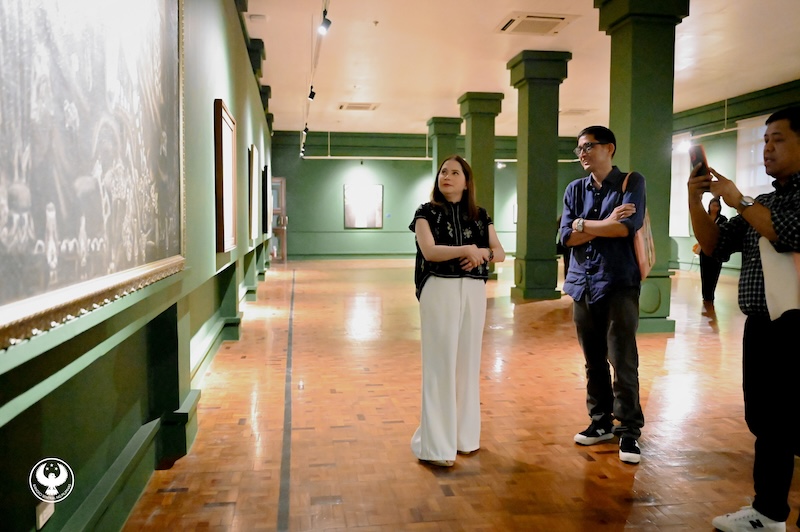
The press preview
Recognizing this demand, Puyat approached Andoni Aboitiz, the chairperson of the National Museum’s Board of Trustees. She asked if the museum could host an exhibition, and it just so happened that Galleries XVIII and XIX had recently become available.
These galleries will now be on loan to the BSP for two years, with a plan to rotate BSP’s artworks. This allows the public to see a large part of the collection over time. The works themselves are acquired by a Committee of Acquisition.
Puyat also shared her perspective on the initiative: “My sector is involved in charge of currency distribution, advocacy, financial inclusion, consumer protection, and communication. This is what faces the public and the stakeholders. The museum is included in our initiatives because it is something the public should be seeing and appreciating.”
Cecille Gelicame, the head of Museo BSP, said the art collection was created as part of BSP’s mission to preserve culture. Its cultural treasures include not only the visual collection, but also a numismatics collection and decorative arts.
The exhibition, titled Pagmulat, is located in Gallery XVIII and features art from the 1970s and 1980s. During this period, artists departed from Western influences and instead explored themes of folk traditions, everyday life, and visual storytelling to communicate the social and political issues of their time.
Two prominent works in the collection explore the complexities of Filipino faith
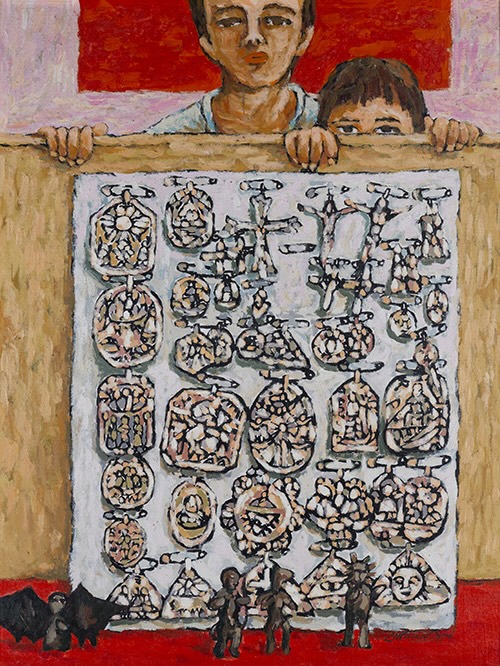
Mario Parial ‘Quiapo’
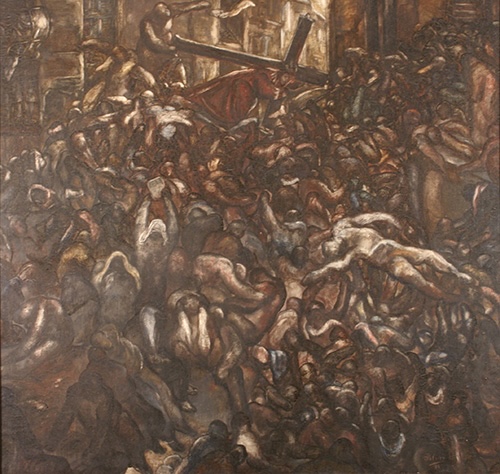
Danilo Dalena’s ‘Enero Nuwebe’ (1982)
Two prominent works in the collection explore the complexities of Filipino faith. In Mario Parial’s 1976 painting, Quiapo, two boys peer over a board displaying various anting-anting (amulets). Similarly, Danilo Dalena’s 1982 work, Enero Nuewebe, depicts the annual feast of the Black Nazarene in Quiapo, where millions of devotees fill the streets during the Traslacion to pray for intercession and give thanks.
Gelicame explains that both pieces evoke the struggles of Filipinos and their resort to religion for comfort and hope. The anting-anting is a particularly potent example, representing a mix of both paganism and Christianity. This deep-rooted faith, she notes, is often a response to desperation and is a reflection of Filipino culture. In his painting, Dalena uses a chaotic composition of blurry figures and sepia tones to convey the emotional intensity and disorder of the event. He intentionally shows the Black Nazarene and the Cross blending into the background, suggesting a distance between religion and the people who seek it.
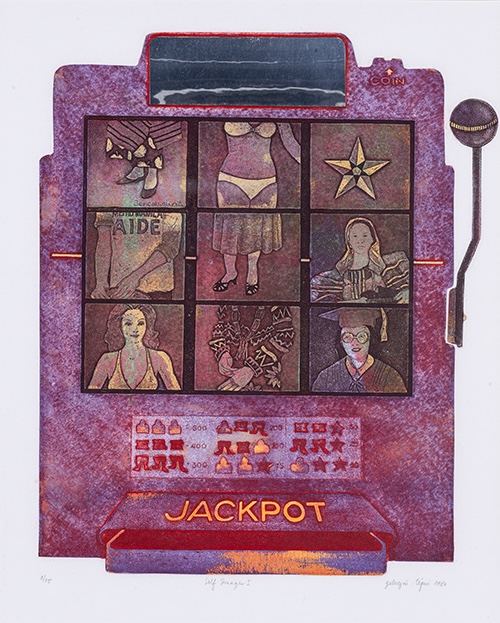
Ofelia Gelvezon Tequi’s ‘Self Images’
Ofelia Gelveson-Tequi’s 1980 intaglio, Self-Images 1, is a relief print which shows a slot machine with cryptic, numbered images, including women’s feet, a torso wearing a bikini, a chair, a star, and a Metro Aid shirt. Below the machine are groups of numbers that determine a winning or losing outcome. The work uses these symbolic images to invite the viewer to engage in self-reflection.
One of the earliest works done in 1972, Tiffany by Onib Olmedo is a figurative expressionist painting that depicts a forlorn woman, often interpreted as a prostitute, in a bar. The work is a prime example of Olmedo’s signature style, characterized by distorted figures and a dark palette, as he sought to capture the inner torment and human spirit of society’s marginalized members.
Located in Gallery XIX, Pagtatanaw looks at art from the late 1980s to the early 2010s. During this time, artists explored themes of identity, personal expression, sustainability, climate change and the self. The exhibition also delves into the artists’ creative process, showing how they developed their work through personal discoveries. The pieces are notably larger in scale and include sculptures.
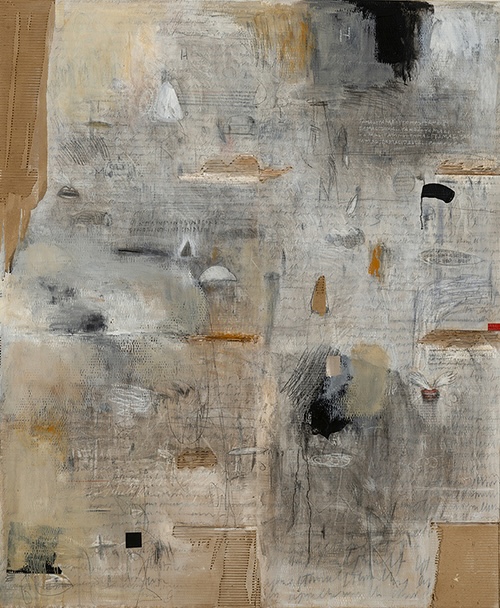
Demetrio Padua’s ‘Hearsay’
Hearsay (2012) by Demetrio de Padua is a precursor to the modern-day “marites” (a Filipino colloquial term for a gossip). The artist layered corrugated cardboard and painted over it to suggest how information, when passed on, is often distorted with added layers. In some areas, the paint is stripped away to reveal the original material, symbolizing how truth can be covered up or intentionally removed.
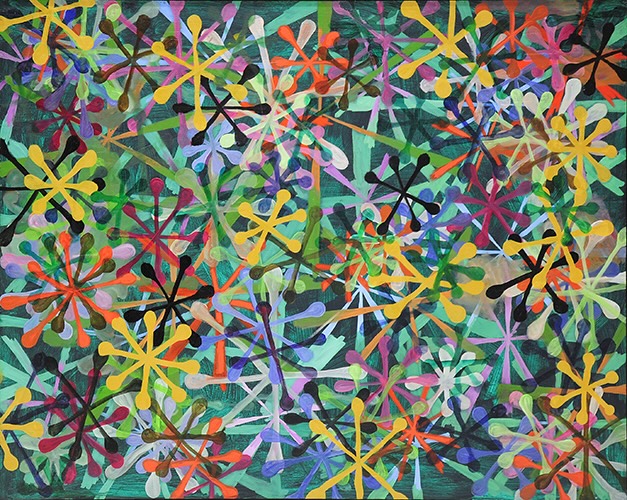
Isabel Cruz’s ‘Milky Way’
Both done in 2013, Maria Isabel Cruz’s Milky Way is an experiment in form. The canvas is filled with a dense pattern of X and triangular shapes, creating a texture that looks like a field of scattered jackstones.
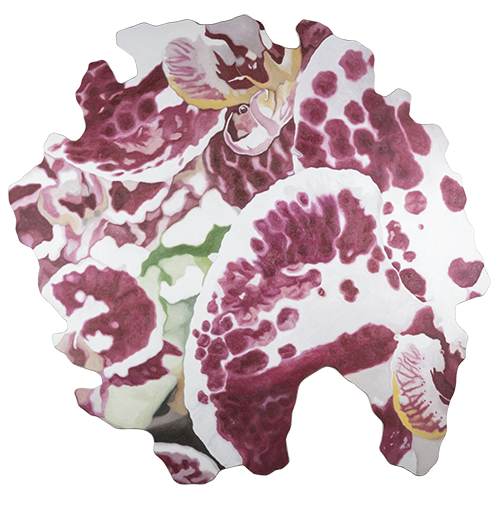
Patricia Perez Eustaquio, Untitled (Butcher’s Blossom)
Patricia Eustaquio’s Butcher’s Blossom resembles a giant slab of marbled steak. Made with layers of red, white, and a hint of green, the work is painted on a canvas that has been cut into an irregular shape, making the very form of the piece a work of art in itself.
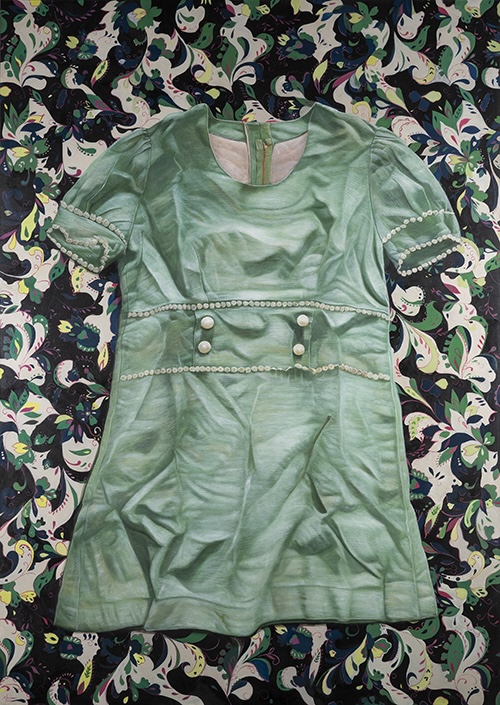
Marina Cruz’s ‘Spring Beauty’
Spring Beauty (2014) by Marina Cruz is a photo-realist painting of a child’s green dress against a patterned background. The piece was inspired by a trove of old clothes the artist discovered from her grandmother while working on her undergraduate thesis. The painting evokes childhood memories of her mother sewing clothes and serves as a reflection on how the craftsmanship of dressmaking has been replaced by modern consumerism. It also comments on the garment industry in her hometown of Hagonoy, Bulacan.
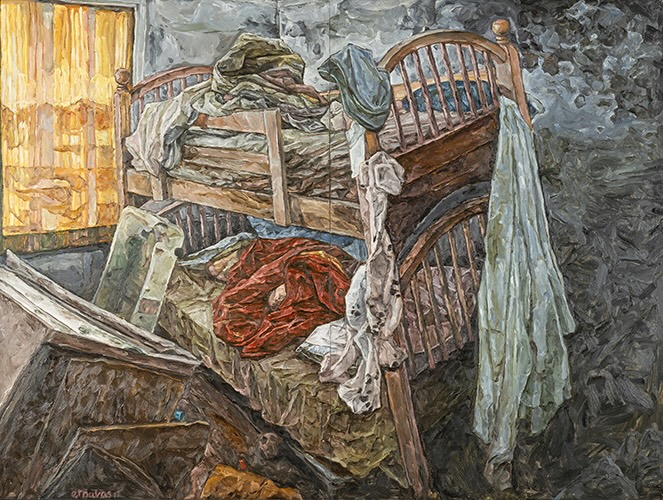
Elaine Navas’ ‘Still Bearing Remnants’ (2012)
Six years after Canadian-American photographer Robert Polidori was assigned by The New Yorker to photograph the impact of Hurricane Katrina in New Orleans, diaspora artist Elaine Navas painted one of his photos in Still Bearing Remnants (2012). Her painting matches Polidori’s meticulous detail and use of color to capture the widespread destruction. The work is an example of Navas’s signature style, characterized by thick, impasto strokes that emphasize texture, depth, and the physical quality of the paint.
The BSP continues its mission to preserve culture by acquiring art. Gelicame says the criteria for acquisition are determined in consultation with scholars, ensuring the selected pieces are of national importance. The artworks are directly sourced from artists and galleries, which constitutes the primary market. As with any government institution, the acquisition process follows specific financial procurement procedures, and all pieces become public property.
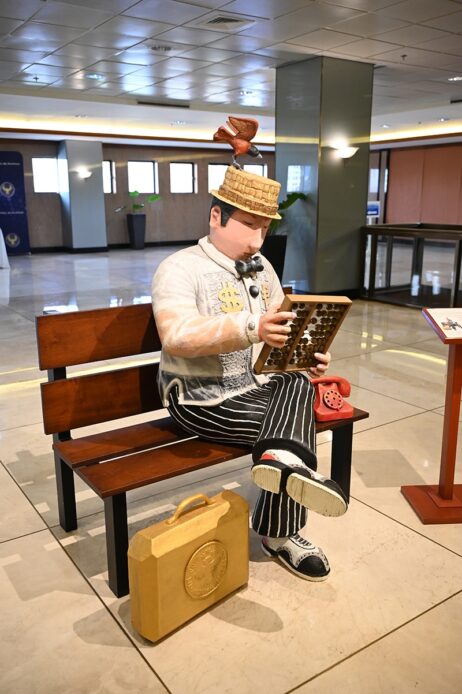
While there are still gaps in the collection, particularly in representing specific periods in art history, the BSP recently made a new acquisition after more than a decade. The new sculpture at the headquarters, titled Si Juan Kaban (Juan Coffer), was commissioned from Bacolod artist Charlie Co. The artwork depicts a Filipino in a barong with currency signs on the garment, sitting on a park bench and working on an abacus, representing the BSP as the government’s role in the country’s financial stability and currency management.
‘It’s wonderful that you can convince just one farmer to open an account’
In a different part of the BSP’s work, Deputy Governor Puyat describes her public-facing role as focusing on financial education and consumer protection. She and her team teach people how to open bank accounts, avoid scams, and protect their savings. Collaborating with various government agencies, Puyat finds great fulfillment in this work. She says, “It’s wonderful that you can convince just one farmer to open an account. You can convince one MSME to save for a rainy day, to have something.”
Puyat, an economics major at the University of the Philippines whose former teachers were BSP Governors Felipe Medalla and Benjamin Diokno, expresses excitement about her position. After serving as Secretary of Tourism, she applied for the job when a vacancy arose, drawn to the idea of working for the government in a quieter way. She enjoys a being surrounded by art such as Amorsolo, H.R. Ocampo and Malang in her office while keeping a more private life and a private social media account.
She acknowledges that art is an important part of her department’s public-facing duties and sees the BSP as a repository for the country’s cultural heritage. Puyat recalls that under Laya, the BSP was particularly active in acquiring art. The institution has a large collection of pieces, including abstract works and old masters, but much of it remains in storage, packed away from public view.
With two galleries at the National Museum, she dreams of having more galleries elsewhere to display the collection, so more people can appreciate them. Her vision seeks to ensure that the nation’s cultural wealth is not merely stored away, but shared with the public it is meant to serve.
The exhibit runs until Nov 15, 2027 at the National Museum of Fine Arts. Free admission
Read more:
At long last, rarely-seen artworks from BSP collection can finally be viewed by the public


